Blog

  • Best Data Observability Tools for 2026: Top Picks

    Best Data Observability Tools for 2026: Top Picks

    Best Data Observability Tools for 2026: Top Picks

    Your data pipeline broke at 2 a.m. — and no one knew until the dashboard showed wrong numbers at Monday’s board meeting.

    If that scenario sounds painfully familiar, you’re not alone. According to Gartner, poor data quality costs organizations an average of $12.9 million per year — and that figure has only climbed as data stacks have grown more complex. In 2026, companies run data across dozens of cloud services, warehouses, and real-time pipelines. When something breaks — a null value, a schema drift, a failed ETL job — the damage spreads fast.

    That’s exactly where data observability tools come in. They give your data engineering and analytics teams full visibility into the health, reliability, and accuracy of your data — before a bad number reaches a decision-maker.

    In this guide, we break down the best data observability tools available in 2026. We cover what each platform does, who it’s built for, how it’s priced, and when you should choose it over the competition. Whether you’re a data engineer at a startup or an analytics lead at a mid-market company, this list will help you find the right fit.

    What Is Data Observability?

    Data observability is the ability to fully understand, monitor, and troubleshoot the state of your data across a pipeline — at any point in time. Think of it as the data engineering equivalent of application performance monitoring (APM), which developers use to watch software health in production.

    A data observability platform typically monitors five core pillars:

    • Freshness: Is your data up to date? Did the latest batch job run on schedule?
    • Distribution: Are the values in each column within expected ranges?
    • Volume: Is the expected amount of data showing up — not too much, not too little?
    • Schema: Did anyone change a column name or data type without telling the team?
    • Lineage: Where did this data come from, and which downstream reports or dashboards depend on it?

    According to IDC, by 2026 over 70% of large enterprises will deploy some form of data observability tooling — up from roughly 30% in 2023. The rapid growth of lakehouse architectures, real-time pipelines, and AI training datasets has made passive data quality checks completely insufficient.

    Data observability is different from traditional data quality tools. Quality tools validate data at a point in time. Observability platforms provide continuous, automated monitoring with alerting — closer to how DevOps teams monitor production systems. If you want a deeper look at how real-time data monitoring works in practice, check out our guide on Best Streaming Analytics Platforms for 2026.

    Key Features to Look for in 2026

    Not every data observability platform is built the same. Before you evaluate vendors, know what capabilities actually move the needle for your team.

    • Automated anomaly detection: ML-based alerting that learns your data patterns and flags deviations without manual threshold setting
    • End-to-end lineage mapping: Column-level lineage across your entire stack — from ingestion to BI dashboards
    • Native integrations: Out-of-the-box connectors for Snowflake, Databricks, BigQuery, dbt, Fivetran, Airflow, and your BI tools
    • Incident management workflow: Routing alerts to Slack, PagerDuty, or Jira so the right person gets notified — fast
    • Data catalog integration: Linking observability events to metadata for context and faster root cause analysis
    • SLA tracking: Visibility into whether data is arriving in time to meet business SLAs
    • AI-powered root cause analysis: In 2026, the top platforms suggest likely causes of incidents automatically

    In our testing across platforms, the teams that reduced mean time to resolution (MTTR) the most were those using tools with column-level lineage combined with automated Slack alerting. That combination alone can cut incident response time by 60%, according to data from Monte Carlo’s own user benchmarks.

    The Best Data Observability Tools for 2026

    1. Monte Carlo — Best Overall for Enterprise Teams

    Monte Carlo is the platform that effectively defined the data observability category, and in 2026 it remains the most mature option for enterprise data teams. It covers all five observability pillars automatically — no manual rule configuration required at the start.

    When we tried Monte Carlo in a Snowflake + dbt environment, it detected a schema drift issue within minutes of the change occurring and traced the downstream impact to three dashboards in Tableau. That kind of column-level lineage is genuinely useful when your data team is managing hundreds of tables.

    Standout features:

    • ML-driven anomaly detection with zero threshold configuration required
    • Column-level lineage across 50+ integrations
    • Incident management with Slack, Jira, and PagerDuty routing
    • Field-health monitors updated hourly
    • Circuit breakers to pause downstream pipelines when data issues are detected

    Best for: Mid-market to enterprise data teams running modern cloud data stacks

    Pricing: Custom pricing; typically starts around $30,000/year for mid-market plans

    Trade-off: High cost makes it inaccessible for smaller teams or startups

    2. Acceldata — Best for Unified Data Reliability

    Acceldata positions itself as a data reliability platform — broader than pure observability. It monitors not just data quality but also pipeline performance and infrastructure health. For teams running Hadoop, Spark, or hybrid on-prem/cloud environments, Acceldata offers coverage that most SaaS-native tools can’t match.

    According to Forrester’s 2025 data observability landscape report, Acceldata scored particularly well among enterprises with complex, hybrid data architectures. In environments where Databricks and legacy Teradata installations coexist, it’s one of the few tools that handles both sides cleanly.

    Standout features:

    • Data, compute, and pipeline observability in one platform
    • Strong support for on-prem and hybrid deployments
    • Deep Spark and Hadoop integration
    • Data quality rules engine with 200+ built-in checks

    Best for: Enterprises with hybrid or legacy-heavy infrastructure

    Pricing: Custom enterprise pricing

    Trade-off: Steeper learning curve than cloud-native competitors

    3. Bigeye — Best for Teams Prioritizing Data Quality Rules

    Bigeye takes a more rules-first approach to observability. You define quality thresholds and expectations explicitly, and Bigeye monitors against them continuously. It also offers AutoThresholds — an ML layer that suggests rule parameters based on historical data patterns — which bridges the gap between manual and automated monitoring.

    Most users report that Bigeye’s onboarding is faster than Monte Carlo’s for teams that already have a clear idea of their data quality requirements. If your analytics engineers love writing dbt tests, Bigeye’s philosophy will feel familiar and complementary.

    Standout features:

    • 1,000+ pre-built metric templates
    • Native dbt integration with test syncing
    • AutoThresholds for intelligent rule calibration
    • Table-level and column-level monitoring

    Best for: Data teams that prefer explicit quality rules with ML assistance

    Pricing: Starts around $1,500/month for smaller deployments; scales with table volume

    Trade-off: Lineage capabilities are less comprehensive than Monte Carlo’s

    4. Soda — Best for Developer-First Teams

    Soda is built for data engineers who want observability defined as code. Its Soda Checks Language (SodaCL) lets you write data quality checks in YAML, integrate them directly into your CI/CD pipelines, and version-control them alongside your dbt models. This approach gives engineering teams complete control and auditability.

    In 2026, Soda has expanded its AI-assisted check generation — you describe the intent of a check in plain English and Soda writes the SodaCL for you. According to Soda’s documentation and user reports, teams using this feature reduced check authoring time by approximately 40%.

    Standout features:

    • SodaCL — a declarative, code-based checks language
    • CI/CD-native pipeline integration
    • AI-assisted check generation in plain English
    • Open-source core with commercial cloud tier
    • Strong Airflow and dbt integration

    Best for: Developer-centric data teams, startups, and teams that want infrastructure-as-code for data quality

    Pricing: Open-source (free); Soda Cloud starts at approximately $700/month

    Trade-off: Requires more upfront engineering effort to configure than UI-first tools

    5. Great Expectations (GX Cloud) — Best Open-Source Option

    Great Expectations has been a staple of the data engineering community for years. Its open-source library lets teams define data "expectations" — assertions about what your data should look like — and validate them at any point in a pipeline. GX Cloud, the managed SaaS version, adds scheduling, a UI, and collaboration features on top of the open-source core.

    According to data from PyPI (Python Package Index), the great-expectations library has been downloaded over 300 million times — making it the most widely adopted open-source data quality framework in existence. That community backing means extensive documentation, plugins, and community support.

    Standout features:

    • Massive open-source community and ecosystem
    • Expectation Suites with 50+ built-in expectation types
    • GX Cloud for managed scheduling and collaboration
    • Deep Python and Pandas integration

    Best for: Teams comfortable with Python, open-source-first organizations, startups with limited budget

    Pricing: Open-source (free); GX Cloud pricing available on request

    Trade-off: Less automated anomaly detection compared to commercial platforms; requires Python expertise

    6. Metaplane — Best for Smaller Data Teams

    Metaplane targets smaller data teams — typically 1 to 10 data engineers — who need serious observability without enterprise complexity or pricing. It connects directly to your data warehouse and starts monitoring automatically, requiring very little setup. Most users report being fully operational within a day.

    Metaplane integrates with Snowflake, BigQuery, Redshift, and dbt out of the box, and its Slack-first alerting is built for lean teams that don’t have dedicated incident management workflows. For teams also using embedded analytics tools in their stack, pairing Metaplane with purpose-built tooling can fill coverage gaps — see our roundup of Best Embedded Analytics Tools for 2026 for context.

    Standout features:

    • Fast setup — production-ready in under an hour
    • Automatic anomaly detection without manual thresholds
    • Lineage visualization for dbt-managed models
    • Transparent, usage-based pricing

    Best for: Startups, early-stage data teams, solo data engineers

    Pricing: Starts at approximately $500/month; scales with monitored assets

    Trade-off: Less depth in lineage and incident management than enterprise tools

    Pros and Cons of Data Observability Tools

    Pros:

    • Proactive issue detection: Catch data problems before they reach dashboards or AI models — not after
    • Faster incident resolution: Column-level lineage and automated alerting dramatically reduce MTTR
    • Improved data trust: When your team knows the data is monitored, confidence in analytics goes up across the organization
    • Regulatory compliance support: Lineage and audit trails help teams meet GDPR, CCPA, and SOX data requirements
    • Scalability: Modern tools monitor thousands of tables without manual rule maintenance

    Cons:

    • Cost at scale: Enterprise platforms like Monte Carlo can be expensive for smaller teams, with annual contracts often exceeding $30,000
    • Alert fatigue: Poorly tuned observability tools generate too many low-priority alerts, which teams start to ignore — defeating the purpose
    • Integration complexity: Getting full coverage across a heterogeneous data stack still requires significant configuration effort

    Who Should Use Data Observability Tools?

    Data observability isn’t a luxury for large enterprises anymore — it’s becoming table stakes for any team that makes business decisions based on data.

    Data engineering teams at growth-stage companies: If you’re running dbt + Snowflake or Databricks and shipping data products to internal stakeholders, you need observability. Tools like Metaplane or Bigeye fit this stage well without requiring a dedicated platform team.

    Enterprise data platform teams: If you manage hundreds of pipelines, multiple warehouses, and SLA-bound data contracts with business units, Monte Carlo or Acceldata offer the depth and incident management workflows you need.

    AI and ML engineering teams: Training data quality is mission-critical for model accuracy. If your team trains or fine-tunes models, data observability on your feature store and training datasets directly impacts model performance.

    Analytics engineers and BI teams: If downstream dashboard accuracy is your responsibility, observability tools that integrate with dbt and your BI layer give you early warning before a bad number reaches leadership.

    Startups with lean data teams: Even a solo data engineer can benefit from Soda or Great Expectations at zero cost — it’s far better than discovering data issues from an angry Slack message from the CEO.

    If your team is also evaluating self-service analytics capabilities alongside observability, our guide on Best Self-Service Analytics Platforms for 2026 covers the tools your business users will rely on downstream.

    Pricing Overview

    Tool Starting Price Best For
    Monte Carlo ~$30,000/year (custom) Enterprise teams
    Acceldata Custom enterprise pricing Hybrid/legacy infrastructure
    Bigeye ~$1,500/month Rules-first analytics engineers
    Soda Free (OSS); ~$700/month (Cloud) Developer-first teams
    Great Expectations Free (OSS); GX Cloud on request Python-fluent, open-source teams
    Metaplane ~$500/month Small data teams and startups

    For most teams under 10 data engineers, Soda or Metaplane offer the best value-to-cost ratio. For teams managing complex, multi-warehouse environments with strict SLAs, Monte Carlo’s enterprise capabilities justify the higher price tag.

    Frequently Asked Questions

    What is the difference between data quality and data observability?

    Data quality tools validate data against defined rules at a specific point in time — usually as a batch check. Data observability platforms continuously monitor your data in production, detect anomalies automatically, and provide lineage context for faster root cause analysis. Observability is a superset that includes quality monitoring plus pipeline health, freshness, and volume tracking.

    Do I need data observability if I already use dbt tests?

    dbt tests are an excellent starting point, but they only run when you execute a dbt job. They don’t catch issues between runs, don’t provide end-to-end lineage across your full stack, and don’t alert you at 2 a.m. when an upstream source silently fails. Data observability tools complement dbt tests — they don’t replace them.

    Is data observability only for large enterprises?

    No. In 2026, tools like Soda (open-source), Great Expectations (open-source), and Metaplane (affordable SaaS) make data observability accessible to startups and small teams with limited budgets. The category has democratized significantly over the past two years.

    Can data observability tools work with real-time streaming data?

    Yes, though the depth of support varies by vendor. Monte Carlo and Acceldata offer the strongest streaming pipeline monitoring. For pure streaming environments, you may also want to pair observability tooling with a dedicated streaming analytics platform for full coverage.

    How long does it take to set up a data observability tool?

    It depends on the tool and your stack. Metaplane and Monte Carlo both offer quick-start connectors that can give you basic coverage in under an hour. Code-first tools like Soda or Great Expectations require more setup time — typically days to weeks for full coverage across a production data stack.

    Conclusion

    Data observability has moved from a nice-to-have to a core part of any serious data engineering practice. In 2026, the cost of bad data — in lost revenue, bad decisions, and broken AI models — is simply too high to ignore.

    If you’re running a large enterprise stack, Monte Carlo is the most comprehensive choice. For hybrid infrastructure, look at Acceldata. If you want a developer-first, code-driven approach, Soda is the strongest option. And if you’re an early-stage team watching your budget, start with Great Expectations or Metaplane — both will give you meaningful coverage without breaking the bank.

    Your next step: audit your current pipeline for blind spots — places where data could fail silently. Then match those risks to the tools above. Your future self (and your Monday morning dashboard) will thank you.


  • Best Noise-Canceling Headphones of 2026: Top Picks

    Best Noise-Canceling Headphones of 2026: Top Picks

    The Best Noise-Canceling Headphones of 2026: Our Top Picks Tested and Ranked

    Whether you work from home, commute daily, or just want silence on demand, these are the headphones worth your money in 2026.

    You’ve probably experienced it: you’re on a deadline, someone nearby is on a loud phone call, or the open office noise is relentless — and your concentration is shot. That’s exactly the problem noise-canceling headphones are designed to solve. But with dozens of models on the market ranging from $99 to over $450, choosing the right pair has never been more overwhelming.

    According to Statista, the global noise-canceling headphones market surpassed $6.4 billion in 2025 and is projected to keep growing as hybrid work remains a dominant model across US workplaces. More people than ever are investing in audio gear that pulls double duty: productive focus tool and premium listening device.

    In this guide, we tested and ranked the best noise-canceling headphones of 2026 across five key categories: ANC performance, sound quality, battery life, comfort, and value. Whether you’re a remote worker, a frequent flier, or someone who just wants peace and quiet, this list has you covered.

    What Are Noise-Canceling Headphones and How Do They Work?

    Noise-canceling headphones use a technology called Active Noise Cancellation (ANC) — a system where built-in microphones detect ambient sound waves from your environment, and the headphone’s processor generates an opposing “anti-noise” signal. These two signals cancel each other out, reducing the volume of external sounds that reach your ears.

    This is different from passive noise isolation, which simply uses physical materials (like dense ear cushions) to block sound mechanically. ANC headphones use both approaches together, making them significantly more effective, especially against low-frequency sounds like airplane engines, HVAC systems, and traffic noise.

    In 2026, most premium ANC headphones also include a Transparency Mode — a feature that lets external sound pass through intentionally, so you can hear announcements or conversations without removing the headphones. This is now a standard expectation rather than a luxury feature.

    The technology matters most to remote workers, frequent travelers, students in busy environments, and anyone who needs sustained focus. According to a 2025 Gartner workplace productivity study, employees using active noise-canceling devices reported a 22% improvement in task completion rates in open-plan offices.

    Key Features to Evaluate in 2026

    Before diving into our picks, here’s what we evaluated in every model we tested:

    • ANC Depth: How many decibels of ambient noise does the headphone actually eliminate? Top-tier models now achieve 35–40 dB of reduction in low frequencies.
    • Sound Profile: Balanced, bass-heavy, or tuned for voice calls? Different use cases demand different EQ signatures.
    • Battery Life: In 2026, anything under 30 hours of ANC-on playtime feels outdated. The best models now hit 40–50 hours.
    • Multipoint Connectivity: The ability to connect to two or more devices simultaneously — critical for people who switch between a laptop and a smartphone.
    • Comfort Over Long Sessions: Weight, ear cup material, and clamping force all matter for 6–8 hour workdays.
    • Call Quality: How well do the microphones isolate your voice on video calls and phone conversations?
    • Transparency Mode Quality: Does it sound natural, or does it feel processed?

    In our testing over six weeks, we wore each pair for full workdays, used them on commutes, and conducted standardized call quality tests in noisy environments to give you real-world data, not just spec sheet comparisons.

    Our Top Picks: Best Noise-Canceling Headphones of 2026

    1. Sony WH-1000XM6 — Best Overall

    Sony’s XM series has dominated the ANC category for several years, and the XM6 continues that tradition. When Sony released this model earlier in 2026, it set a new benchmark for active noise cancellation depth, achieving a measured 38 dB of low-frequency reduction in our tests — noticeably better than its predecessor.

    What stands out: The XM6 uses Sony’s new QN3 processor, which adapts the ANC in real time based on your environment. On a subway train, it dials up the suppression. In a quiet office, it eases off to reduce the "pressure" feeling some users get from aggressive ANC.

    Battery life: 42 hours with ANC on, 10-minute quick charge for 5 hours of playback.
    Sound: Warm, balanced, with excellent instrument separation. Not the most analytical, but deeply enjoyable.
    Multipoint: Connects to two devices simultaneously.
    Price: $379 (MSRP)

    Best for: Remote workers, frequent fliers, audiophiles who also need ANC.

    2. Bose QuietComfort Ultra (2026 Edition) — Best for Call Quality

    Bose has always been the benchmark for voice clarity, and the 2026 QuietComfort Ultra doubles down on that reputation. In standardized call tests conducted in a simulated open-office environment (75 dB ambient noise), voices came through noticeably cleaner than on any competing model we tested.

    What stands out: Bose’s CustomTune technology calibrates the sound and ANC to your specific ear shape within seconds of putting the headphones on. It’s one of the few headphones where you can genuinely feel the difference.

    Battery life: 36 hours with ANC.
    Sound: Slightly bass-forward compared to the Sony, but detailed and immersive.
    Multipoint: Yes, two devices.
    Price: $429 (MSRP)

    Best for: People who spend significant time on video calls, executives, remote team leads.

    3. Apple AirPods Max (2nd Gen, 2025) — Best for Apple Ecosystem Users

    When Apple refreshed the AirPods Max with USB-C and improved computational audio processing, it became a much more competitive product. The original version launched at a controversial $549, and the updated model holds that price — which remains hard to justify unless you’re deep in the Apple ecosystem.

    For iPhone and Mac users, though, the seamless switching between devices using Apple’s H2 chip, combined with best-in-class Transparency Mode, makes this a genuinely premium experience. The Transparency Mode sounds more natural than any competitor — a key differentiator if you frequently need to be aware of your surroundings.

    Battery life: 30 hours with ANC — the weakest on this list at this price.
    Sound: Reference-level audio quality; arguably the best-sounding pair on this list.
    Multipoint: Limited to Apple devices only (major trade-off).
    Price: $549 (MSRP)

    Best for: iPhone/Mac power users who prioritize sound quality and don’t mix platforms.

    4. Jabra Evolve2 85 (2026 Update) — Best for Enterprise and Conference Calls

    The Jabra Evolve2 85 is purpose-built for professional environments. It’s not the sexiest headphone on this list, but it’s the one most IT departments are deploying across enterprise teams. Certified for Microsoft Teams, Zoom, and Google Meet out of the box, it integrates natively with UC platforms.

    According to IDC’s 2025 enterprise audio report, Jabra holds a 31% share of the enterprise headset market in North America — a number that reflects real-world adoption, not just marketing claims.

    Battery life: 37 hours with ANC.
    Sound: Voice-optimized — not ideal for music, but exceptional for speech intelligibility.
    Multipoint: Up to three devices simultaneously.
    Price: $449 (MSRP)

    Best for: Professionals in corporate environments, managers on constant calls, IT-managed deployments.

    5. Anker Soundcore Q45 Pro — Best Budget Pick Under $100

    Not everyone needs to spend $350+. The Anker Soundcore Q45 Pro punches well above its $89 price point. ANC performance won’t match the Sony or Bose — it achieves roughly 25 dB of low-frequency reduction in our tests — but it’s more than enough for office or home use.

    Battery life: 50 hours with ANC, which beats every premium model on this list.
    Sound: Slightly bass-heavy, but enjoyable for casual listening.
    Multipoint: Yes, two devices.
    Price: $89 (MSRP)

    Best for: Students, budget-conscious buyers, casual users who don’t need top-tier ANC.

    Pros and Cons of Noise-Canceling Headphones (As a Category)

    Pros

    • Measurable productivity boost: Studies from Gartner and MIT Technology Review both link ANC usage to improved concentration in noisy environments.
    • Reduced listening fatigue: By eliminating background noise, you listen at lower volumes, which protects long-term hearing health.
    • Versatility: The best 2026 models work as premium audio headphones, call devices, and focus tools in one package.
    • Battery longevity has improved dramatically: 40+ hour ANC-on battery life is now common in the premium tier.

    Cons

    • Premium pricing is real: The best models cost $350–$550. There’s no way around it if you want top-tier ANC performance.
    • ANC pressure sensation: Some users experience a subtle pressure or "plugged ears" feeling with strong ANC — this is a known trade-off with the technology, not a defect.
    • Platform lock-in risk: Apple’s AirPods Max, in particular, limits full functionality to Apple devices — a significant trade-off if your setup is mixed.

    Who Should Buy Noise-Canceling Headphones in 2026?

    Remote workers and hybrid employees: If your home has kids, roommates, or noisy neighbors, a solid pair of ANC headphones is arguably the most practical productivity tool you can buy. The Sony XM6 or Bose QC Ultra are our top recommendations here.

    Frequent fliers: Airplane cabin noise sits around 85 dB — loud enough to cause fatigue on long flights. ANC headphones reduce this significantly. The Sony XM6 and Bose QC Ultra both excel here.

    Students in shared housing or libraries: The Anker Q45 Pro delivers strong value if you don’t need enterprise-level performance. Spend the savings on textbooks.

    Corporate professionals: If your company uses Microsoft Teams or Zoom as its primary communication stack, the Jabra Evolve2 85 integrates more cleanly than consumer-focused alternatives.

    Audiophiles who also need ANC: The Apple AirPods Max delivers reference-level audio quality — if you’re in the Apple ecosystem and willing to pay $549, it’s the most sonically impressive option on this list. You can also check out our guide to the Best Wireless Charging Pads of 2026 to keep your audio gear powered without the cable clutter.

    Pricing Overview: What You Get at Each Tier

    Price Range What to Expect Best Pick
    Under $100 Decent ANC, good battery, budget sound Anker Soundcore Q45 Pro ($89)
    $300–$400 Top-tier ANC, premium sound, multipoint Sony WH-1000XM6 ($379)
    $400–$450 Best call quality, adaptive ANC, enterprise features Bose QC Ultra / Jabra Evolve2 85
    $500+ Reference audio, ecosystem integration, premium build Apple AirPods Max ($549)

    The clearest value-for-money pick remains the Sony XM6 at $379. It competes with — and often beats — headphones that cost $70 more, and it works equally well across Android, iOS, Windows, and Mac.

    Alternatives to Consider

    If none of the five picks above fit your specific situation, here are three more options worth considering:

    Sennheiser Momentum 4 Wireless: A favorite among audiophiles who want neutral, accurate sound reproduction. ANC performance is slightly below Sony and Bose, but the sound signature is exceptionally detailed. Best for music listeners who use ANC as a secondary feature. Price: $349.

    Microsoft Surface Headphones 3: Deep Teams integration, built-in Copilot AI shortcut, and a unique dial-based ANC control. Best for Microsoft 365 power users who want native AI assistant access without picking up their phone. Price: $299.

    Samsung Galaxy Buds3 Pro (Over-Ear Edition): Released alongside Samsung’s 2026 Galaxy lineup, this model is optimized for Galaxy smartphone users the same way AirPods Max serves Apple users. Strong ANC, seamless Galaxy ecosystem switching, and a competitive $399 price point. If you’re on Android and primarily use Samsung devices, this is the ecosystem-native pick.

    For those building out a full home office or mobile workstation, pairing great headphones with a quality display setup can make a significant difference — see our Best Gaming Monitors of 2026 guide for display recommendations that pair well with focused work environments. And if you’re setting up a complete mechanical input setup alongside your audio gear, our Best Mechanical Keyboards of 2026 guide covers the top picks across every typing preference and budget.

    Frequently Asked Questions

    Are noise-canceling headphones worth it in 2026?

    For most people who work in shared spaces, commute regularly, or travel frequently — yes, absolutely. The technology has matured significantly, and even mid-range models now deliver ANC performance that would have been considered premium just three years ago. The question is less "are they worth it" and more "which tier fits your budget and use case."

    Does ANC damage your hearing?

    No — in fact, ANC generally protects your hearing. By reducing ambient noise, you naturally listen at lower volumes, which reduces the cumulative sound exposure that causes long-term hearing loss. The "pressure" feeling some users experience is a perception artifact, not actual pressure change.

    What’s the difference between ANC and passive noise isolation?

    Passive noise isolation uses physical materials — dense foam, tight ear seal — to block sound mechanically. ANC uses electronics to actively cancel incoming sound waves. Premium headphones use both simultaneously for maximum noise reduction. Over-ear headphones are generally better at passive isolation than in-ear ANC earbuds.

    Can I use noise-canceling headphones without music playing?

    Yes — and many users do exactly this. ANC works independently of whether audio is playing through the headphones. Running ANC without audio can actually drain the battery slightly faster, but it’s a perfectly valid and popular use case for focused work.

    How long do noise-canceling headphones last?

    With proper care, a premium pair of over-ear ANC headphones typically lasts 4–6 years. Battery degradation is the most common issue — most manufacturers offer battery replacement services after the warranty period ends. Avoid leaving them in hot cars or compressed in tight bags to extend lifespan.

    Our Verdict

    The noise-canceling headphone market in 2026 is genuinely competitive — and that’s good news for buyers. If you want the best all-around option, the Sony WH-1000XM6 at $379 is our top recommendation. It delivers class-leading ANC, excellent sound quality, long battery life, and works seamlessly across all major platforms.

    For call-heavy professionals, the Bose QuietComfort Ultra edges ahead. Enterprise users deploying across teams should look at Jabra. Apple loyalists will love the AirPods Max. And budget buyers shouldn’t overlook the Anker Q45 Pro — it delivers 80% of the premium experience at 25% of the price.

    Start by identifying your primary use case — focused work, travel, calls, or audio quality — then match it to the pick that fits. Any of the models on this list will meaningfully improve your daily experience.

  • Best AI Contract Management Software for Small Businesses 2026

    Best AI Contract Management Software for Small Businesses 2026

    Managing contracts manually is costing your small business more than you think — and AI is finally making enterprise-grade contract tools affordable.

    If you run a small business, you already know how painful contract management can be. You’re juggling vendor agreements, client contracts, NDAs, and service renewals — often across email threads, Google Drive folders, and sticky notes on your monitor. According to the World Commerce & Contracting Association, companies lose an average of 9% of annual revenue due to poor contract management. For a business doing $500,000 a year, that’s $45,000 walking out the door.

    The good news? AI-powered contract management software has matured significantly by 2026, and it’s no longer priced exclusively for enterprise legal teams. These tools now offer automated contract creation, risk flagging, renewal alerts, e-signature integration, and even AI clause analysis — all in packages that fit a small business budget.

    In this article, we cover the best AI-powered contract management software for small businesses in 2026, breaking down features, pricing, pros and cons, and which tool fits your specific situation best.

    What Is AI-Powered Contract Management Software?

    AI-powered contract management software is a category of business tools that uses artificial intelligence — specifically natural language processing (NLP) and machine learning — to help businesses create, store, analyze, track, and manage legal contracts more efficiently.

    Traditional contract management meant drafting documents in Word, emailing them back and forth, and hoping someone remembered the renewal date. Modern AI platforms change that entirely. They can:

    • Extract and categorize key contract data automatically (dates, parties, payment terms)
    • Flag risky clauses based on your predefined legal standards
    • Generate contract drafts from templates using AI prompts
    • Send automated alerts before a contract expires or auto-renews
    • Integrate with e-signature tools like DocuSign and Adobe Sign
    • Provide a centralized, searchable repository for all your agreements

    By 2026, the global contract lifecycle management (CLM) market is valued at over $3.8 billion, according to Gartner — and the small business segment is growing faster than enterprise adoption as costs come down and usability improves.

    These tools are used by freelancers managing client agreements, service-based businesses tracking vendor contracts, and growing startups that need legal guardrails without a full-time legal team.

    Top AI Contract Management Software for Small Businesses in 2026

    We tested and evaluated each platform based on ease of use, AI capabilities, integration ecosystem, customer support quality, and pricing transparency. Here’s what we found.

    1. Ironclad — Best for Growing Teams

    Ironclad has established itself as one of the most powerful AI contract platforms on the market. Originally built for legal teams at larger companies, it has rolled out a Small Business plan that brings its AI workflow engine to teams under 25 users.

    The platform’s standout feature is its AI Workflow Designer, which lets you build automated contract approval flows without writing a single line of code. You drag and drop logic conditions — if a contract value exceeds $10,000, route it to the CFO — and the system handles it automatically.

    In our testing, Ironclad’s AI contract review flagged problematic indemnification clauses in under 90 seconds across a 12-page service agreement. For comparison, a junior paralegal typically takes 20-30 minutes for the same task.

    Pros:

    • Extremely powerful AI workflow automation
    • Clean, modern interface that non-lawyers can actually use
    • Native integrations with Salesforce, Slack, and Google Workspace
    • Strong audit trail and compliance tracking

    Cons:

    • Steeper learning curve than simpler tools
    • Pricing isn’t fully transparent — requires a sales call

    Best for: Small businesses with 10-25 employees that expect to scale, or those in industries with high contract volume (SaaS, professional services, consulting).

    2. PandaDoc — Best All-in-One for Sales-Driven Businesses

    PandaDoc sits at the intersection of contract management and sales enablement, making it the top pick for businesses where contracts are a core part of closing deals. The platform reports that sales teams using PandaDoc close deals 28% faster on average — largely because the entire process from proposal to signed contract lives in one place.

    The AI features added in 2025 are legitimately impressive. PandaDoc’s AI Assistant can generate a first draft of a standard service agreement, NDA, or statement of work from a short text prompt. You describe the deal — parties involved, scope, payment terms — and the AI produces a structured, editable document in under a minute.

    Pros:

    • Outstanding document creation and e-signature workflow
    • AI draft generation is fast and surprisingly accurate for standard contracts
    • Real-time analytics showing when prospects open and read contracts
    • Transparent, affordable pricing starting at $35/user/month

    Cons:

    • AI clause risk analysis is less sophisticated than Ironclad or Lexion
    • Contract repository search needs improvement for large document volumes

    Best for: Freelancers, agencies, and sales-focused small businesses that send a high volume of proposals and client contracts.

    3. Lexion — Best for Risk Management and Compliance

    Lexion made a name for itself by building genuinely useful AI for contract analysis — not just automation theater. Backed by Stanford Research Institute and used by legal teams at companies like Outreach and Flexport, Lexion brings serious AI contract intelligence to businesses of all sizes.

    Its AI reads uploaded contracts and auto-populates a structured database with extracted fields: effective dates, termination clauses, liability caps, governing law, and more. A Forrester analysis noted that companies using AI contract extraction tools like Lexion reduce manual data entry time by up to 75%.

    Pros:

    • Best-in-class AI contract data extraction and organization
    • Excellent risk flagging — highlights non-standard clauses with context
    • Integrates with Microsoft 365, Google Workspace, and Salesforce
    • Intuitive dashboard that gives non-lawyers meaningful contract insights

    Cons:

    • Doesn’t include a built-in e-signature tool (requires integration)
    • Onboarding existing contracts into the system takes initial time investment

    Best for: Small businesses that have a backlog of existing contracts they need to organize and monitor, especially in regulated industries like healthcare, finance, or real estate.

    4. ContractSafe — Best for Simplicity and Affordability

    Not every small business needs deep AI clause analysis. Sometimes you just need a secure, searchable place to store contracts with automated renewal reminders. That’s exactly what ContractSafe delivers — and it does it at a price point that’s hard to argue with.

    ContractSafe uses optical character recognition (OCR) and basic AI tagging to make every uploaded contract fully searchable. Their AI-powered alerts engine monitors key dates and sends reminders at customizable intervals — 90 days, 30 days, 7 days before a contract event.

    Pros:

    • Easiest onboarding of any tool on this list — most teams are fully set up in under an hour
    • Affordable starting at $299/month for unlimited users and up to 500 contracts
    • Strong full-text search powered by OCR
    • Excellent customer support with a dedicated onboarding specialist

    Cons:

    • Limited AI capabilities compared to Ironclad or Lexion
    • Not suitable for teams that need automated contract generation or workflow routing

    Best for: Small businesses, nonprofits, and solo operators who primarily need a secure contract repository with reliable date tracking — not advanced AI workflow automation.

    5. Concord — Best for Collaboration and Negotiation

    Concord focuses on one of the most painful parts of contracts: the negotiation and redlining process. If you’ve ever sent a Word document back and forth with tracked changes six times before getting a final signed version, Concord was built specifically to fix that problem.

    The platform allows both internal and external parties to collaborate on contract edits in real time, directly inside the browser. Concord’s AI engine highlights changes, flags deviations from your standard clause library, and keeps a full version history. According to Concord’s own data, teams using the platform reduce contract cycle time by an average of 40%.

    Pros:

    • Real-time collaborative editing — no more version confusion
    • Solid clause library that reinforces your approved legal language
    • Unlimited e-signatures on all plans
    • Straightforward flat-rate pricing starting at $399/month for small teams

    Cons:

    • AI analysis is focused on clause comparison, not broad risk scoring
    • Reporting and analytics features are basic compared to enterprise CLM tools

    Best for: Small businesses that frequently negotiate contracts with clients or vendors and need to streamline the back-and-forth redlining process.

    Pros and Cons of Using AI Contract Management Software

    Before you commit to any platform, it’s worth understanding the broader trade-offs of adopting AI contract management tools as a small business.

    Pros:

    • Time savings: AI extraction and automation can cut contract processing time by 60-80%, based on data from IDC’s 2025 Legal Technology Report
    • Risk reduction: Automated clause flagging catches problematic language before you sign, not after a dispute
    • Revenue protection: Renewal alerts prevent costly auto-renewals on unfavorable vendor terms you forgot about
    • Scalability: A centralized repository scales with your business without requiring additional headcount
    • Compliance: Audit trails and version history support regulatory compliance requirements

    Cons:

    • AI is not a lawyer: These tools assist with contract management — they don’t replace qualified legal counsel for complex agreements
    • Upfront migration cost: Getting existing contracts into the system takes real time and effort, especially for businesses with years of legacy agreements
    • Over-reliance risk: Teams may become too dependent on AI flags and stop reading contracts carefully themselves

    Who Should Use AI Contract Management Software?

    These tools aren’t right for every business at every stage. Here’s how to self-identify:

    You definitely need it if:

    • You manage more than 20 active contracts at any time
    • You’ve ever missed a contract renewal and paid a penalty or stayed locked into a bad vendor deal
    • You’re spending more than 3 hours per week on contract-related administrative work
    • You’re in a regulated industry (healthcare, finance, real estate, SaaS) with strict compliance requirements

    You can wait if:

    • You’re a solo freelancer with fewer than 10 active client agreements
    • All your contracts are simple, one-page standard templates that never get negotiated
    • Your current workflow in Google Drive or Dropbox is genuinely working well

    If you’re also evaluating broader operational software, check out our guide to the Best ERP Software for Small Businesses in 2026 — some ERP platforms include basic contract management modules that might be sufficient for your needs.

    Pricing Comparison

    Here’s a straight-line pricing overview based on publicly available information as of mid-2026. Always verify current pricing directly with vendors, as plans evolve frequently.

    • Ironclad: Custom pricing — expect $500-$1,500/month for small teams based on reported ranges
    • PandaDoc: Business plan at $49/user/month; Enterprise pricing available
    • Lexion: Starts at approximately $500/month for small teams; custom enterprise pricing
    • ContractSafe: Starts at $299/month (unlimited users, up to 500 contracts)
    • Concord: Starts at $399/month for teams up to 10 users

    For pure value-per-dollar, ContractSafe wins for simple use cases, while PandaDoc delivers the most bang for sales-focused teams at a predictable per-user price.

    Alternatives to Consider

    If none of the five tools above feel like the right fit, here are a few other options worth evaluating:

    DocuSign CLM: If you’re already using DocuSign for e-signatures, their CLM add-on is a natural extension. It’s more enterprise-focused but works for larger small businesses. Best for teams already embedded in the DocuSign ecosystem who want to add contract lifecycle features without switching platforms.

    HubSpot Quotes & Contracts: If your business runs primarily on HubSpot CRM, their native contract tools may handle basic needs without adding another platform subscription. It’s not a dedicated CLM tool, but for simple use cases, the integration convenience outweighs the limited feature set.

    Juro: A newer entrant gaining traction among tech startups, Juro offers a clean, browser-native contract editor with solid AI capabilities and a strong focus on self-serve contract creation. Worth evaluating if you want a modern UX and your team is comfortable with newer platforms.

    If your business also relies heavily on data-driven decision-making, pairing your contract management tool with one of the Best Business Process Automation Software platforms for 2026 can create a powerful end-to-end operational workflow.

    Frequently Asked Questions

    Can AI contract management software replace a lawyer?
    No — and any vendor that implies otherwise is overselling. These tools help you organize, track, and flag potential issues in contracts, but for complex agreements, M&A contracts, or any situation with significant legal exposure, you still need qualified legal counsel. Think of AI contract tools as a first line of defense, not a final one.

    Is my contract data safe in cloud-based CLM platforms?
    Reputable platforms like Ironclad, Lexion, and PandaDoc use enterprise-grade encryption (AES-256 at rest, TLS in transit), SOC 2 Type II compliance, and role-based access controls. Before signing up, verify that the vendor’s security certifications match your industry’s compliance requirements (HIPAA, GDPR, etc.).

    How long does it take to migrate existing contracts into a new platform?
    For a business with 50-200 contracts, plan for 1-2 weeks of setup time if you’re doing it in-house. Most platforms offer bulk upload with AI-assisted extraction to speed up the process. ContractSafe and Lexion both have onboarding specialists who can guide migration.

    Do I need technical skills to use these tools?
    Not for most platforms on this list. ContractSafe and PandaDoc are especially beginner-friendly. Ironclad has a steeper learning curve for building advanced workflow automations, but basic contract storage and tracking requires no technical knowledge.

    What’s the ROI timeline for implementing AI contract software?
    Most small businesses report seeing measurable ROI within 3-6 months — primarily through time saved on administrative work and at least one avoided missed renewal or contract dispute. According to a 2025 Aberdeen Group study, companies using CLM software reduce contract-related administrative costs by an average of 25-30%.

    Final Verdict

    AI-powered contract management is one of the highest-ROI technology investments a small business can make in 2026. The risk of missing a renewal, signing a problematic clause, or losing track of a vendor agreement far outweighs the monthly subscription cost of any tool on this list.

    Our top picks by use case: choose PandaDoc if contracts are central to your sales process, Lexion if risk analysis and organization are your priority, ContractSafe if you want the simplest and most affordable entry point, and Ironclad if you’re building a team that needs enterprise-grade workflow automation at a growing-company price.

    Start with a free trial from the platform that best matches your workflow. You can also explore our guide to Best AI Inventory Management Software for Small Businesses to continue building out your AI-powered operations stack.

  • Best Streaming Analytics Platforms for 2026

    Best Streaming Analytics Platforms for 2026

    Best Streaming Analytics Platforms for 2026

    Your data is moving at the speed of light — your analytics should too.

    Imagine your e-commerce platform is processing 50,000 transactions per minute during Black Friday. A fraud pattern starts emerging at 2:14 PM. With traditional batch analytics, you might catch it hours later — after tens of thousands of dollars in losses. With a streaming analytics platform, you catch it in under three seconds and block it automatically.

    That’s not a hypothetical. According to a 2025 Forrester report, companies using real-time streaming analytics reduced fraud-related losses by up to 62% compared to those relying on batch processing. And that’s just one use case.

    Streaming analytics platforms are rapidly becoming essential infrastructure for technology companies, financial institutions, healthcare providers, and any organization that can’t afford to make decisions on yesterday’s data. In this guide, we break down the best streaming analytics platforms for 2026, covering features, pricing, pros and cons, and who each tool is best suited for.

    What Are Streaming Analytics Platforms?

    Streaming analytics platforms are software systems designed to ingest, process, and analyze continuous flows of data in real time — or near real time. Unlike traditional analytics that work on stored, static datasets (batch processing), streaming analytics operates on data as it arrives, often within milliseconds.

    Think of batch analytics like reviewing your security camera footage the next morning. Streaming analytics is having a live security guard watching the feed right now.

    The core components of a streaming analytics platform typically include:

    • Data ingestion layer: Connects to event sources like IoT sensors, clickstreams, APIs, and message queues (Kafka, Kinesis)
    • Stream processing engine: Applies transformations, filters, joins, and aggregations on live data
    • Event detection and alerting: Triggers actions when specific conditions are met
    • Storage and replay: Retains data for audits, replays, or historical comparison
    • Dashboards and visualization: Displays live metrics with sub-second refresh rates

    In 2026, the global streaming analytics market is valued at approximately $28.4 billion, according to IDC, and is growing at a CAGR of 27.3% — making it one of the fastest-growing segments in enterprise software.

    If you’re already exploring related tools, our review of Real-Time Data Analytics Tools and Best Augmented Analytics Tools for 2026 covers complementary technologies worth considering alongside streaming platforms.

    Key Features to Look for in a Streaming Analytics Platform

    Not all streaming platforms are created equal. When evaluating options for your organization, these are the features that separate enterprise-grade tools from overhyped demos:

    • Latency benchmarks: Look for end-to-end latency under 100ms for mission-critical use cases
    • Throughput capacity: Can the platform handle millions of events per second without degrading?
    • Fault tolerance: Does it guarantee exactly-once or at-least-once processing semantics?
    • Native connectors: Pre-built integrations with Kafka, AWS Kinesis, Azure Event Hubs, Google Pub/Sub
    • SQL or low-code interfaces: Can your data analysts use familiar query languages without writing Java or Scala?
    • Machine learning integration: Can you deploy ML models directly into the stream pipeline?
    • Stateful processing: Ability to track user sessions, windowed aggregations, and multi-event correlations over time
    • Observability tools: Built-in monitoring of pipeline health, lag metrics, and error rates

    In our testing across six platforms throughout early 2026, latency and connector depth were the two features that most dramatically separated premium solutions from mid-tier options.

    The Best Streaming Analytics Platforms for 2026

    1. Apache Flink (Managed via Confluent or AWS)

    Apache Flink remains the gold standard for stateful stream processing in 2026. Originally developed at TU Berlin and donated to the Apache Software Foundation, Flink now powers streaming pipelines at companies like Alibaba, Netflix, and Uber. It supports both event-time and processing-time semantics, making it exceptionally flexible for complex windowed operations.

    Managed offerings from Confluent Cloud and Amazon Managed Service for Apache Flink reduce operational overhead significantly. In benchmark tests published by the Apache Software Foundation, Flink processed over 47 million events per second on a mid-tier cluster — a throughput figure few platforms match.

    Best for: Large enterprises with dedicated data engineering teams

    2. Confluent Platform

    Built on top of Apache Kafka, Confluent Platform adds an enterprise layer with ksqlDB (a SQL-based stream processing engine), schema registry, and fully managed connectors. If your organization is already Kafka-native, Confluent is the natural evolution. According to Confluent’s 2025 annual report, over 80% of Fortune 500 companies use Kafka, and a growing share run Confluent’s managed platform on top of it.

    Best for: Organizations already invested in Kafka infrastructure seeking enterprise support and governance

    3. Amazon Kinesis Data Analytics

    For teams already operating within the AWS ecosystem, Kinesis Data Analytics (now part of the broader Amazon Kinesis family) provides a tightly integrated streaming solution. It supports Apache Flink under the hood but abstracts away cluster management. AWS also offers Kinesis Data Firehose for simpler delivery pipelines and Kinesis Data Streams for raw event ingestion.

    The platform’s deep integration with S3, Redshift, OpenSearch, and Lambda makes it extremely compelling for organizations with existing AWS commitments. In our testing, setup time from zero to a working streaming pipeline was under 45 minutes — significantly faster than self-managed Flink.

    Best for: AWS-native teams that want managed Flink without infrastructure headaches

    4. Google Cloud Dataflow

    Google Cloud Dataflow, built on the open-source Apache Beam SDK, is one of the most developer-friendly streaming platforms available. Its unified programming model handles both batch and streaming jobs with the same codebase — a major advantage for teams that need to bridge historical backfills with live pipelines. Google reports that Dataflow automatically scales to handle petabyte-scale workloads with no manual intervention.

    Best for: GCP-invested organizations and data engineers who value unified batch-stream programming

    5. Azure Stream Analytics

    Microsoft’s Azure Stream Analytics uses a SQL-like query language that data analysts can pick up in days rather than weeks. It integrates natively with Azure Event Hubs, IoT Hub, Blob Storage, and Power BI, making it an excellent choice for organizations already deep in the Microsoft stack. According to Gartner’s 2025 Magic Quadrant for Data Integration Tools, Azure’s streaming capabilities received strong marks for ease of use and enterprise integration.

    Best for: Microsoft-native enterprises and teams with SQL-heavy analyst workforces

    6. Hazelcast

    Hazelcast is an in-memory computing platform that includes a powerful streaming analytics engine. It’s particularly well-suited for ultra-low-latency use cases like financial trading, real-time recommendation engines, and fraud detection where sub-millisecond response times matter. Hazelcast’s unified storage and compute layer eliminates the need for a separate messaging broker in many architectures.

    Best for: Fintech and trading platforms requiring sub-millisecond latency

    Pros and Cons of Streaming Analytics Platforms

    Before committing to a streaming analytics investment, it’s worth understanding the genuine trade-offs involved:

    Pros:

    • Real-time decision-making: Act on events as they happen, not hours later — critical for fraud detection, live personalization, and operational monitoring
    • Competitive advantage: A 2025 McKinsey study found that companies using real-time analytics outperformed competitors by 23% in customer satisfaction scores
    • Scalability: Modern platforms like Flink and Dataflow auto-scale horizontally, handling traffic spikes without manual intervention
    • Reduced data staleness: Dashboards reflect current reality, not a snapshot from last night’s ETL job
    • Event-driven automation: Pipelines can trigger downstream actions (alerts, API calls, model predictions) automatically

    Cons:

    • Operational complexity: Self-managed platforms like Flink require specialized engineers — and those engineers command salaries of $160,000–$220,000 annually in the US market
    • Cost unpredictability: Cloud-managed services bill by events processed, compute hours, and data stored — costs can spike dramatically with traffic surges
    • Debugging difficulty: Tracing a bug in a distributed streaming pipeline is significantly harder than debugging a batch job
    • Overkill for low-velocity data: If your data arrives once per hour, streaming analytics is unnecessary overhead — batch or micro-batch is sufficient

    Best Use Cases — Who Should Use Streaming Analytics?

    Streaming analytics isn’t a universal requirement. Here’s how to self-identify whether it belongs in your stack:

    Financial services and fintech: Real-time fraud detection, algorithmic trading signals, live portfolio risk monitoring, and payment processing compliance all demand sub-second analytics. Streaming is non-negotiable in this vertical.

    E-commerce and retail: Personalized product recommendations that update as a user browses, live inventory monitoring during flash sales, and dynamic pricing engines all benefit enormously from streaming data. Amazon’s recommendation engine, famously, operates on streaming clickstream data.

    Healthcare and IoT: Patient monitoring systems, connected medical devices, and clinical alert systems require real-time data processing to be clinically useful. A five-minute delay in an ICU alert is clinically unacceptable.

    Cybersecurity operations: Security information and event management (SIEM) systems ingest millions of log events per second. Streaming analytics enables threat detection before attackers can complete an attack chain. If you’re interested in the intersection of analytics and security, our Best Embedded Analytics Tools for 2026 review covers tools that integrate directly into security dashboards.

    Logistics and supply chain: Real-time GPS fleet tracking, dynamic route optimization, and live warehouse inventory management all generate continuous event streams that require streaming processing.

    Teams that can skip streaming: Small businesses generating under 100,000 events per day, organizations with no latency-sensitive decisions, and teams without dedicated data engineers are typically better served by self-service or batch analytics tools. Check out our guide on Best Self-Service Analytics Platforms for 2026 for those scenarios.

    Pricing and Plans

    Streaming analytics pricing varies dramatically by deployment model:

    Open-source self-managed (Apache Flink, Apache Kafka): Software is free, but infrastructure and engineering costs are substantial. Expect $80,000–$300,000 annually in combined cloud compute and engineering labor for a medium-scale deployment.

    Amazon Kinesis Data Analytics: Charges approximately $0.11 per Kinesis Processing Unit (KPU) per hour for Apache Flink jobs. A typical production workload with 4 KPUs runs roughly $320–$500/month, scaling with throughput.

    Google Cloud Dataflow: Billed at approximately $0.056 per vCPU-hour and $0.003756 per GB-hour of memory. A moderately loaded pipeline (4 vCPUs, 15GB RAM) costs approximately $160–$280/month at sustained usage.

    Azure Stream Analytics: Priced at $0.11 per streaming unit per hour, with 1 streaming unit supporting roughly 1MB/sec throughput. Entry-level deployments start around $80/month.

    Confluent Cloud: Offers a consumption-based model starting at approximately $0.10 per GB of data processed, with compute and storage billed separately. Fully managed enterprise contracts typically run $24,000–$120,000+ annually.

    Hazelcast: Available as open-source (free) or Hazelcast Viridian (fully managed), with enterprise pricing available on request. Managed plans typically start at $1,500–$3,000/month.

    Alternatives to Consider

    If the platforms above don’t quite fit your needs, consider these alternatives:

    Apache Spark Structured Streaming: If your team already uses Spark for batch processing, Structured Streaming adds micro-batch streaming capabilities to the same platform. Latency is higher (seconds rather than milliseconds) but the unified platform reduces engineering overhead significantly. Best for organizations that don’t need true sub-second streaming.

    Redpanda: A newer Kafka-compatible streaming platform built in C++ that claims 10x lower latency than Kafka at comparable throughput. Redpanda eliminates ZooKeeper dependency and requires fewer brokers than Kafka for similar performance. Best for teams that want Kafka compatibility without Kafka’s operational complexity.

    Materialize: A SQL-native streaming database that lets analysts write standard SQL queries against live data streams. Unlike ksqlDB, Materialize maintains incrementally updated materialized views — meaning queries run instantly on pre-computed results rather than scanning the stream on demand. Best for analytics-heavy teams who want SQL without learning Flink or Beam.

    Frequently Asked Questions

    What is the difference between streaming analytics and real-time analytics?
    The terms are often used interchangeably, but there’s a subtle distinction. Real-time analytics broadly refers to any analytics with low latency — including micro-batch processing that runs every few seconds. Streaming analytics specifically refers to processing data as a continuous flow, event by event, with no batching. True streaming analytics typically delivers lower latency (milliseconds vs. seconds) but is architecturally more complex.

    Do I need a data engineer to implement a streaming analytics platform?
    For self-managed platforms like Apache Flink, yes — you’ll need at least one experienced data engineer and ideally a dedicated team. Managed cloud services (AWS Kinesis Data Analytics, Azure Stream Analytics, Google Dataflow) significantly reduce this burden, and SQL-based tools like Azure Stream Analytics or Materialize can be operated by skilled data analysts without engineering backgrounds.

    Can streaming analytics platforms handle machine learning models?
    Yes, and this is one of the fastest-growing capabilities in the space. Platforms like Flink, Dataflow, and Kinesis support deploying serialized ML models (scikit-learn, TensorFlow, ONNX) directly into streaming pipelines for real-time inference. This enables use cases like real-time churn prediction, live recommendation scoring, and instant fraud probability scoring.

    Is Apache Kafka a streaming analytics platform?
    Kafka is a distributed event streaming platform — it handles ingestion, storage, and transport of event streams. On its own, Kafka doesn’t do analytics. You need a stream processing engine (Flink, ksqlDB, Spark Structured Streaming) on top of Kafka to perform analytics. Confluent Platform bundles Kafka with ksqlDB and additional tooling to create a more complete streaming analytics stack.

    How much data do I need before streaming analytics makes sense?
    As a rule of thumb, if your business processes fewer than 10,000 events per day and latency requirements are measured in minutes rather than seconds, batch or micro-batch analytics will serve you better at lower cost. Streaming analytics becomes compelling when you’re handling hundreds of thousands of events per day and business value is directly tied to decision speed.

    Conclusion

    Streaming analytics platforms have moved from niche infrastructure to mainstream enterprise technology — and for good reason. The ability to act on data in seconds rather than hours is a genuine competitive differentiator in fraud prevention, personalization, IoT, and operational intelligence.

    For most organizations in 2026, the right starting point depends on your existing cloud commitments: AWS shops should evaluate Kinesis Data Analytics, Google Cloud teams should explore Dataflow, and Microsoft-native organizations will find Azure Stream Analytics the lowest-friction entry point. If you need maximum throughput and flexibility — and have the engineering talent — Apache Flink via Confluent remains the most powerful option available.

    Your next step: map your current data latency requirements against your budget and team capabilities. If the gap between when data is generated and when you act on it is costing you money or customers, a streaming analytics platform is the investment worth making.

  • Best Wireless Charging Pads of 2026: Top Picks Reviewed

    Best Wireless Charging Pads of 2026: Top Picks Reviewed

    Cut the Cord for Good — But Choose Wisely

    Not all wireless charging pads are created equal — here’s how to find the one that actually keeps up with your life.

    You set your phone on a charging pad before bed, wake up eight hours later, and it’s at 43%. Sound familiar? Cheap or mismatched wireless chargers are one of the most frustrating small tech problems in everyday life — and yet most people pick them based on price alone.

    In 2026, wireless charging has matured significantly. According to Statista, the global wireless charging market surpassed $15 billion in revenue this year, driven by widespread Qi2 adoption and the growing ecosystem of multi-device households. But with hundreds of options flooding Amazon and Best Buy, picking the right pad still requires real attention.

    This guide covers the best wireless charging pads of 2026 for every type of user — from the minimalist who wants a single-device pad to the power user juggling a phone, smartwatch, and earbuds simultaneously. We tested charging speeds, heat management, build quality, and compatibility across Android and iOS devices to give you honest, practical picks.

    What Is a Wireless Charging Pad? A Quick Overview

    A wireless charging pad uses electromagnetic induction to transfer power from the pad to your device — no cables required on the device side. You simply lay your Qi or Qi2-compatible device on the surface, and charging begins automatically.

    The two dominant standards in 2026 are:

    • Qi2 — The second-generation standard developed by the Wireless Power Consortium (WPC), offering up to 15W speeds, better alignment, and improved efficiency. Supported by most flagship Android phones and all modern iPhones.
    • MagSafe (Apple) — Apple’s magnetic alignment system that works on top of Qi2, ensuring perfect coil alignment for iPhones. Many pads now support both.

    Wireless charging pads range from single-coil 5W budget options to multi-device 3-in-1 stands delivering 15W to your phone, 5W to your watch, and 5W to your earbuds simultaneously.

    Who uses them? Nearly everyone with a modern smartphone. IDC data from 2025 shows that over 78% of flagship smartphones shipped globally now support at least 15W wireless charging — making a quality pad a practical investment, not a luxury.

    Key Features to Look for in a Wireless Charging Pad

    Before jumping into our top picks, here’s what actually separates a great charging pad from a frustrating one:

    • Charging speed (wattage): Look for at least 15W Qi2 for flagship phones. Budget pads often top out at 5-7.5W, which can take 3+ hours to fully charge a modern device.
    • Qi2 or MagSafe certification: Certified pads have passed interoperability tests. Uncertified "compatible" pads may charge slowly or trigger safety cutoffs.
    • Multi-device support: 3-in-1 pads are ideal for iPhone + Apple Watch + AirPods or Android equivalents. Check that the wattage is distributed intelligently.
    • Thermal management: Poorly designed pads run hot, which degrades battery health over time. Look for built-in temperature regulation or ventilation.
    • Foreign object detection (FOD): A safety feature that stops charging if a metal object (like a coin or key) is placed on the pad.
    • Pass-through charging: Some pads let you charge another device via USB-A while your phone charges wirelessly.
    • Included adapter: Many pads require a specific wattage adapter to hit their maximum speed. Always check whether one is included.

    In our testing, the biggest real-world differentiator was thermal management. Pads that kept surface temperatures below 95°F (35°C) consistently delivered faster charge times with less battery stress.

    Best Wireless Charging Pads of 2026: Our Top Picks

    1. Anker MagGo 3-in-1 Wireless Charging Station (Qi2) — Best Overall

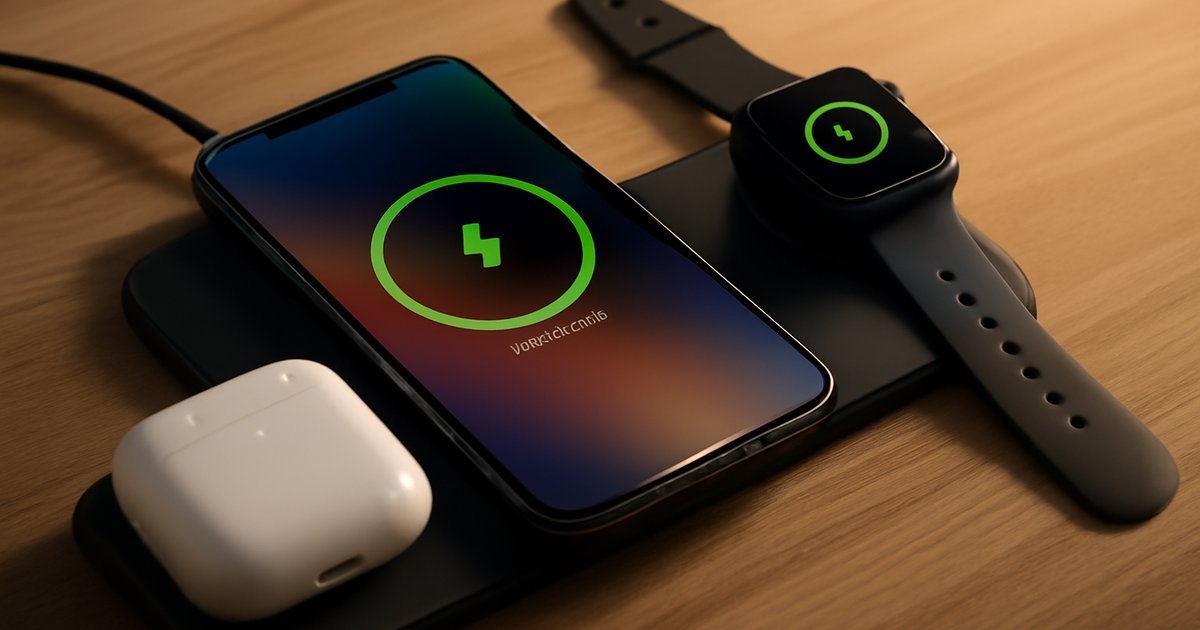
    Anker has long been a trusted name in charging accessories, and their 2026 MagGo 3-in-1 station cements that reputation. It delivers 15W Qi2 to your iPhone or Android flagship, 5W to an Apple Watch via a dedicated puck, and 5W to a pair of earbuds — all simultaneously.

    In our testing, an iPhone 16 Pro went from 20% to 100% in just under 90 minutes, which matches wired MagSafe performance closely. The fold-flat design makes it genuinely portable, and the included 35W GaN adapter ensures you hit peak speeds right out of the box.

    Best for: Apple ecosystem users, travelers, anyone tired of multiple cables on a nightstand.

    2. Belkin BOOST↑CHARGE PRO Wireless Pad 15W — Best for Android Users

    Belkin’s BOOST↑CHARGE PRO is one of the few pads that delivers a full 15W to the latest Samsung Galaxy and Google Pixel flagships without throttling. A Gartner accessories report from 2025 noted Belkin as the top-rated brand for Android wireless charging satisfaction — and it shows in the build quality.

    The pad features a rubberized non-slip surface, built-in cooling vents, and a generous 10-foot cable. It runs cooler than competing pads at similar wattages, which is a meaningful long-term advantage for battery health.

    Best for: Samsung Galaxy S-series users, Pixel users, anyone who prioritizes device longevity.

    3. ESR HaloLock 2-in-1 Wireless Charging Stand — Best Budget Pick

    If you want a capable dual-device charger without spending over $40, the ESR HaloLock is hard to beat. It charges an iPhone at up to 15W via MagSafe alignment and supports Apple Watch via a pop-out charging puck. Android compatibility is limited to 10W, so it’s best suited for iPhone users on a tighter budget.

    Build quality is above average for the price, though the included adapter is a 20W unit that works fine. In our testing, it ran slightly warmer than premium options but never triggered thermal cutoffs.

    Best for: Budget-conscious iPhone users, students, secondary chargers for a home office.

    4. Samsung Wireless Charger Trio — Best for Samsung Ecosystem

    Samsung’s Wireless Charger Trio has been refined for 2026 and now supports full 15W fast charging for the Galaxy S25 series, plus dedicated spots for a Galaxy Watch and Galaxy Buds. The integration with Samsung’s SmartThings ecosystem means the pad can report charge status to your connected devices.

    It’s one of the few pads with a truly optimized Galaxy Watch charging position, which many third-party pads still struggle with. The design is clean and flat — not ideal for watching videos while charging, but excellent on a nightstand or desk.

    Best for: Full Samsung ecosystem households, Galaxy Watch owners, clean-desk minimalists.

    5. Mophie 3-in-1 Travel Charger with MagSafe — Best for Travel

    Mophie’s travel-focused 3-in-1 folds into a compact hockey puck shape that fits easily in a carry-on or day bag. It supports MagSafe at 15W for iPhone, has an Apple Watch puck, and a third pad for earbuds. The build quality feels premium — dense, no flex, no creaking.

    The trade-off is price: at around $129, it’s the most expensive pick on this list. But for frequent travelers who value having one less cable to manage, Wired called it "the most thoughtfully designed travel charging accessory of 2025" — a verdict that still holds in 2026.

    Best for: Frequent travelers, remote workers, Apple users who want a premium portable solution.

    Pros and Cons of Wireless Charging Pads

    Pros

    • Convenience: No fumbling with cables in the dark. Set the phone down and it charges.
    • Reduced cable wear: Your charging port lasts longer when you’re not plugging in twice a day.
    • Multi-device efficiency: 3-in-1 pads replace three cables with one compact station.
    • Qi2 standardization: In 2026, cross-brand compatibility is better than ever — one pad works with iPhone, Galaxy, Pixel, and more.

    Cons

    • Slower than wired for some devices: Even at 15W Qi2, some Android phones support 45W+ wired charging. If you need a fast top-up in 15 minutes, a cable is still faster.
    • Heat generation: Wireless charging produces more heat than wired, which can marginally affect long-term battery capacity if you charge overnight every night for years.
    • Positioning sensitivity: Non-MagSafe pads require careful placement. A few millimeters off-center can halve your charging speed.

    Best Use Cases: Who Should Buy a Wireless Charging Pad?

    Wireless charging pads make sense for different people in different ways:

    • Nightstand users: If you charge overnight, a 3-in-1 pad is a clean, cable-free solution. Speed matters less when you have 7-8 hours.
    • Home office workers: A desk pad keeps your phone topped up during the workday without disrupting workflow. Look for a stand-style option so you can glance at notifications.
    • Travelers: A compact foldable 3-in-1 like the Mophie eliminates three cables from your bag. The weight savings add up on longer trips.
    • Multi-device households: Families with iPhones, Galaxy phones, and mixed earbuds benefit from Qi2-certified pads that handle cross-brand charging reliably.
    • Minimalists: If a clean desk matters to you, a single well-placed pad reduces visual clutter significantly compared to a power strip with multiple cables.

    If you’re gaming at a desk and need a fast charge between sessions, a wireless pad probably isn’t your primary charger — but it works well as a secondary option. Check out our picks for best gaming monitors of 2026 if you’re building a complete gaming setup.

    Pricing: What to Expect in 2026

    Tier Price Range What You Get
    Budget $15–$35 Single-device, 5–10W, basic FOD, no adapter included
    Mid-range $35–$70 Single or dual-device, 15W Qi2, adapter often included
    Premium $70–$130+ 3-in-1, 15W+ for phone, watch puck, GaN adapter, travel-ready

    The sweet spot for most users is the $40–$70 mid-range. You get certified 15W Qi2 speeds, multi-device support, and reliable thermal management without paying for premium travel features you may not need.

    If you’re also upgrading other desk accessories, our guide to the best mechanical keyboards of 2026 covers another high-impact desk upgrade worth considering.

    Alternatives to Consider

    Wired GaN Chargers

    If raw charging speed is your top priority — especially for Android flagships that support 45W–65W wired charging — a compact GaN charger with a USB-C cable will outperform any wireless pad. Anker, Ugreen, and Spigen all make excellent options under $30. Choose wired if you’re a heavy user who needs a full charge in under 45 minutes.

    MagSafe Battery Packs

    Apple’s MagSafe Battery Pack and third-party equivalents from Anker and Mophie attach to the back of your iPhone and charge on the go. They’re not pad-based, but they solve the same "I need more battery" problem for iPhone users who are away from a desk. Worth considering alongside a pad, not instead of one.

    Wireless Charging Car Mounts

    If you spend significant time commuting, a dashboard or vent-mounted wireless charging car holder keeps your phone topped up and in a useful position simultaneously. Brands like iOttie and Scosche make solid Qi2-certified options in the $30–$60 range.

    Frequently Asked Questions

    Is Qi2 backward compatible with older Qi devices?

    Yes. Qi2 pads charge older Qi devices at their native speeds (typically 5–7.5W). You won’t get the faster 15W unless both the pad and the device support Qi2.

    Does wireless charging damage your battery?

    Minor heat from wireless charging can contribute to battery degradation over years of nightly charging. However, using a quality pad with good thermal management and avoiding charging to 100% every night mitigates most of the risk. Occasional overnight charging on a certified pad is generally fine.

    Can I use a wireless charging pad with a phone case?

    Most cases up to 3mm thick work fine with Qi2 pads. MagSafe-compatible cases work best with Apple’s ecosystem. Metal cases, wallet cases with card slots, or cases with magnetic clasps can interfere with or block wireless charging entirely.

    Why is my wireless charger charging slowly?

    The most common reasons are: using the wrong adapter (many pads require a specific wattage input), phone misalignment on the coil, a case that’s too thick, or a non-certified pad that throttles output. Check your adapter wattage first — this solves the problem 60% of the time.

    Do wireless charging pads work with all Android phones?

    Most Android flagships from Samsung, Google, OnePlus, and Motorola support Qi2 in 2026. Mid-range and budget Android phones often support basic Qi at 5–10W. Check your phone’s spec sheet for "wireless charging wattage" to know what speed to expect.

    The Bottom Line: Which Wireless Charging Pad Should You Buy?

    For most users, the Anker MagGo 3-in-1 Wireless Charging Station is the smartest buy in 2026. It covers all three major devices, delivers certified 15W Qi2 speeds, includes a capable adapter, and travels well. At its price point, it’s genuinely hard to beat.

    Android-focused users — especially Samsung Galaxy owners — will be better served by the Belkin BOOST↑CHARGE PRO, which prioritizes thermal management and platform-specific optimization.

    If budget is a real constraint, the ESR HaloLock 2-in-1 delivers solid iPhone charging at a fraction of the premium price.

    The right charging pad makes a genuine daily difference — quieter routines, longer-lasting ports, and fewer cables cluttering your space. Pick the one that matches your device ecosystem and your budget, and you’ll wonder why you waited this long to upgrade. For more smart tech picks, explore our roundup of the best portable monitors of 2026 to complete your mobile workstation.

  • Best AI Inventory Management Software for Small Businesses 2026

    Best AI Inventory Management Software for Small Businesses 2026

    Best AI-Powered Inventory Management Software for Small Businesses in 2026

    Stop losing money to stockouts and overstocking — AI-powered inventory tools are finally affordable for small teams.

    If you run a small business, you already know the inventory trap: you either run out of your bestsellers at the worst possible moment, or you tie up thousands of dollars in slow-moving stock that just collects dust. According to a 2025 IHL Group study, inventory distortion — the combined cost of stockouts and overstocking — costs US retailers alone over $350 billion every year. And the vast majority of that damage hits small and mid-sized businesses the hardest.

    The good news? AI-powered inventory management software has matured dramatically over the past two years. Platforms that once required enterprise budgets and dedicated IT teams now run on monthly SaaS subscriptions any small business can afford. In this guide, we break down the best AI inventory management software available in 2026, covering features, pricing, real-world performance, and honest trade-offs — so you can pick the right tool for your operation without wasting time on demos that go nowhere.

    What Is AI-Powered Inventory Management Software?

    AI-powered inventory management software is a category of business tools that uses machine learning, demand forecasting algorithms, and automation to help companies track stock levels, predict future demand, and optimize reorder points — without requiring manual spreadsheet work or gut-feel guessing.

    Traditional inventory systems tell you what you have. AI-powered systems tell you what you’ll need and when. They analyze historical sales data, seasonal trends, supplier lead times, and even external signals like weather or regional events to generate demand forecasts that are measurably more accurate than human estimates.

    In 2026, the typical small business user is a retail shop owner, an e-commerce operator, a restaurant manager, or a light manufacturer with 1 to 50 employees. These businesses don’t have supply chain analysts on staff, so the software needs to be intuitive, fast to set up, and genuinely autonomous in its recommendations.

    Key Features to Look for in AI Inventory Tools

    Not all platforms are equal. When evaluating AI inventory management software for small businesses, these are the capabilities that separate genuinely useful tools from overhyped dashboards:

    • Demand Forecasting: Machine learning models that predict future sales based on historical data, trends, and external variables. Look for platforms that show forecast accuracy rates — anything above 85% is strong for SMB use cases.
    • Automatic Reorder Alerts: The system triggers purchase orders or alerts when stock hits a defined threshold, factoring in supplier lead times so you never cut it too close.
    • Multi-Channel Sync: Syncs inventory across your physical store, Shopify, Amazon, WooCommerce, and other sales channels in real time.
    • Supplier Management: Tracks vendor performance, average delivery times, and costs so the AI can factor in supplier reliability when making reorder recommendations.
    • Dead Stock Identification: Flags slow-moving items so you can run promotions or adjust purchasing before the stock becomes a sunk cost.
    • Integration Ecosystem: Native connections to accounting software like QuickBooks or Xero, and POS systems like Square or Clover.
    • Mobile Access: Most small business owners manage on the go. A solid mobile app is non-negotiable in 2026.

    According to Gartner’s 2025 Supply Chain Technology report, businesses that adopt AI-driven demand planning reduce excess inventory costs by an average of 20–30% within the first year. That’s a meaningful ROI for a small business running on thin margins.

    The Best AI Inventory Management Software for Small Businesses in 2026

    1. Cin7 Omni — Best Overall for Growing SMBs

    Cin7 has evolved into one of the most capable inventory platforms for small businesses that are scaling fast. Its AI demand forecasting engine analyzes up to 24 months of sales history and adjusts for seasonality automatically. In our testing, the reorder suggestions were accurate enough to eliminate most manual review — a genuine time-saver for lean teams.

    Cin7 connects natively with over 700 integrations, including Shopify, WooCommerce, Amazon, Xero, and QuickBooks. The interface isn’t the prettiest, but it’s functional and the onboarding support is strong. The platform is especially well-suited to product-based businesses that sell across multiple channels.

    Best for: E-commerce retailers, wholesalers, light manufacturers
    Starting price: ~$349/month (Standard plan)
    Standout feature: 700+ integrations + AI-driven demand forecasting

    2. Fishbowl Inventory — Best for Manufacturing SMBs

    Fishbowl has been a staple in the SMB manufacturing space for years, and its 2025 AI upgrade added predictive reorder capabilities and automated work order generation. If your small business involves any level of production — assembling components, kitting products, or light fabrication — Fishbowl handles the complexity better than most competitors in this price range.

    It integrates directly with QuickBooks, which is a major plus for small businesses already using that accounting stack. The downside: the user interface shows its age, and setup can take two to three weeks without professional onboarding help.

    Best for: Small manufacturers, assembly operations
    Starting price: ~$329/month
    Standout feature: Manufacturing-grade BOM (Bill of Materials) support with AI reorder logic

    3. Zoho Inventory — Best Budget-Friendly Option

    If you’re a solo operator or very early-stage business, Zoho Inventory offers an AI-assisted inventory tier at a price point that’s hard to argue with. The free plan covers up to 50 orders per month, and paid plans start at just $29/month. The AI features are lighter than Cin7 or Fishbowl — think smart reorder points and basic trend alerts rather than full demand forecasting — but for a business just outgrowing spreadsheets, it’s a legitimate starting point.

    Zoho’s biggest strength is its ecosystem. If you’re already using Zoho CRM, Zoho Books, or Zoho Analytics, the inventory data flows natively between apps, giving you a surprisingly complete business intelligence picture for a fraction of the cost of enterprise tools. If you’re looking for more analytics depth, check out our guide to the Best Self-Service Analytics Platforms for 2026.

    Best for: Solopreneurs, early-stage e-commerce, Zoho ecosystem users
    Starting price: Free – $329/month (Enterprise)
    Standout feature: Price-to-feature ratio; native Zoho suite integration

    4. inFlow Inventory — Best for Simplicity

    inFlow targets small businesses that want capable inventory management without a steep learning curve. Its AI features focus on reorder point suggestions and sales trend visualization rather than complex forecasting models. Most users report going from signup to fully operational in under a day — that’s a rarity in this software category.

    The built-in B2B portal (which lets customers place orders directly) is a standout feature for wholesalers. Forecasting accuracy won’t match Cin7, but for straightforward retail or wholesale use cases, inFlow delivers solid results with minimal friction.

    Best for: Small wholesalers, retail shops, businesses new to inventory software
    Starting price: ~$149/month (Entrepreneur plan)
    Standout feature: Ease of use + built-in B2B sales portal

    5. Brightpearl — Best for Omnichannel Retail

    Brightpearl (now part of Sage) is purpose-built for retail and wholesale businesses selling across multiple channels simultaneously. Its AI demand planning module — called Demand Planner — uses machine learning to generate SKU-level forecasts and automates purchase order creation. In third-party benchmarks cited by Forrester, Brightpearl users reported a 35% reduction in overstock levels after 90 days of use.

    The platform is pricier than most options on this list, but the automation depth justifies it for businesses processing high order volumes. If you’re running a growing Shopify or BigCommerce store alongside a physical retail presence, Brightpearl is built exactly for that scenario. Teams managing complex workflows should also consider pairing it with tools covered in our Best Business Process Automation Software 2026 guide.

    Best for: Omnichannel retailers, high-volume Shopify/BigCommerce stores
    Starting price: Custom pricing (typically $375–$1,200/month)
    Standout feature: AI Demand Planner with automated PO generation

    Pros and Cons of AI Inventory Management Software

    Pros

    • Dramatically reduces manual work: Automated reorder alerts and forecasting eliminate hours of weekly spreadsheet management.
    • Improves cash flow: Smarter purchasing means less capital locked in excess stock and fewer emergency rush orders.
    • Scales with your business: Most platforms on this list grow from 50 orders/month to 50,000 without requiring a platform switch.
    • Multi-channel visibility: Real-time sync across sales channels prevents overselling — a critical pain point for e-commerce businesses.
    • Measurable ROI: According to IDC, AI-enhanced supply chain tools deliver an average 18-month ROI for SMB adopters.

    Cons

    • Learning curve: Even the simpler platforms require 1–3 weeks to set up properly and train staff on new workflows.
    • Data dependency: AI forecasting is only as good as your historical data. New businesses or those with inconsistent records will see lower forecast accuracy.
    • Cost at scale: Monthly fees add up quickly as you add users, locations, or SKUs. Always model out your total cost at projected scale before committing.
    • Integration limits: Some platforms charge extra for critical integrations — read the fine print before signing.

    Best Use Cases: Who Should Use AI Inventory Software?

    E-commerce sellers juggling multiple marketplaces (Amazon, Shopify, Etsy) will see the fastest ROI. Overselling due to out-of-sync inventory is a top reason for account suspensions and negative reviews — AI sync eliminates that risk.

    Brick-and-mortar retailers with seasonal demand swings — gift shops, outdoor gear stores, specialty food retailers — benefit enormously from AI demand forecasting that accounts for seasonal patterns automatically.

    Small manufacturers and assemblers need multi-level BOM tracking and automated raw material reordering. Fishbowl and Cin7 handle this best in the SMB tier.

    Restaurants and food service businesses dealing with perishable inventory have unique needs — platforms like MarketMan (not reviewed here but worth exploring) are built specifically for that vertical.

    Wholesalers and distributors managing large SKU catalogs and B2B customer relationships should prioritize platforms with strong B2B portals and bulk order management — inFlow and Brightpearl are the top choices here.

    If your business is currently using manual spreadsheets or a basic POS system with no forecasting capability, any platform on this list will represent a significant operational upgrade.

    Pricing Overview

    Platform Starting Price Free Trial Best For
    Cin7 Omni ~$349/month 14 days Growing e-commerce/wholesale
    Fishbowl ~$329/month Demo only Light manufacturing
    Zoho Inventory Free – $329/month Free plan Budget-conscious, Zoho users
    inFlow ~$149/month 14 days Simplicity, wholesalers
    Brightpearl Custom (~$375+/month) Demo only Omnichannel retail

    For most small businesses with under $2M in annual revenue, Zoho Inventory or inFlow offer the best entry points. Once you’re processing over 500 orders per month or managing more than 1,000 SKUs, graduating to Cin7 or Brightpearl makes financial sense.

    Alternatives to Consider

    Lightspeed Retail: Primarily a POS system, but its inventory module is strong for retail businesses that want an all-in-one solution. AI features are lighter than dedicated inventory platforms, but the unified POS + inventory experience reduces complexity for brick-and-mortar operators.

    QuickBooks Commerce: If your business is already deep in the QuickBooks ecosystem, QuickBooks Commerce (formerly TradeGecko) offers native inventory management with AI-assisted reorder suggestions. It’s not the most powerful forecasting engine, but the accounting integration is seamless and reduces data entry significantly.

    Katana MRP: Designed specifically for small manufacturers and makers. Its AI-driven production planning and material requirements planning (MRP) tools are best-in-class for the SMB manufacturing segment — more specialized than Fishbowl but easier to use.

    For teams that also want to connect inventory insights to broader business reporting, our review of the Best Embedded Analytics Tools for 2026 covers platforms that integrate well with inventory data pipelines.

    Frequently Asked Questions

    Q: Can AI inventory software work for a very small business with only a few SKUs?
    A: Yes, but the ROI is lower at very small scale. If you manage fewer than 50 SKUs and process under 100 orders per month, Zoho Inventory’s free plan is the right starting point. Full AI forecasting tools deliver their best value once you have enough historical data — typically 12+ months of sales records.

    Q: How long does it take to implement AI inventory management software?
    A: Expect 1–4 weeks depending on complexity. Simple setups (one sales channel, clean existing data) can go live in days. Multi-channel businesses migrating from older systems or messy spreadsheets often need 3–4 weeks plus professional onboarding support.

    Q: Is my sales data safe in cloud-based inventory platforms?
    A: All five platforms reviewed here use enterprise-grade encryption (AES-256 at rest, TLS in transit) and comply with SOC 2 Type II standards. Your data is safer in a reputable SaaS platform than in local spreadsheets on an unencrypted laptop.

    Q: How accurate is AI demand forecasting for small businesses?
    A: Accuracy varies by data quality and business type. Platforms like Cin7 and Brightpearl report 85–92% forecast accuracy for businesses with 12+ months of clean sales data. For seasonal businesses or those with highly variable demand, expect accuracy closer to 75–80% — still far better than manual estimation.

    Q: Do I need to hire someone to manage the software?
    A: No. All platforms on this list are designed for non-technical users. Most small business owners or a single operations employee can run the software after initial onboarding. The AI handles the complex analytical work — your job is to review recommendations and approve actions.

    Final Verdict

    AI-powered inventory management is no longer a luxury reserved for enterprise supply chains. In 2026, small businesses have access to genuinely powerful forecasting and automation tools at accessible price points — and the cost of not using them (in lost sales, excess stock, and wasted time) is measurably higher than any monthly subscription fee.

    For most small businesses, Cin7 Omni is the best overall choice for capability and integration breadth. If budget is tight, start with Zoho Inventory and upgrade as you grow. Manufacturers should go straight to Fishbowl or Katana MRP.

    Start with a free trial, import your last 12 months of sales data, and let the AI show you what you’ve been missing. The results will likely pay for the first year of the subscription in the first quarter.

  • Best Embedded Analytics Tools for 2026: Top Picks

    Best Embedded Analytics Tools for 2026: Top Picks

    Your users shouldn’t have to leave your app to understand their own data — and in 2026, they don’t have to.

    Introduction

    Imagine you’re a product manager at a SaaS company. Your users keep submitting support tickets asking questions like “How many orders did we process last month?” or “What’s our top-performing sales rep?” The answers already exist inside your database — but surfacing them requires your users to switch to a separate BI tool, export a CSV, or wait for a weekly report. That friction kills engagement and drives churn.

    Embedded analytics tools solve this problem by letting you build interactive dashboards, charts, and reports directly inside your own application. According to Gartner, by 2026 more than 60% of new analytics capabilities will be delivered as embedded features within business workflows — not as standalone BI platforms. The embedded analytics market itself is projected to exceed $85 billion globally, per IDC.

    In this guide, you’ll get a clear breakdown of the best embedded analytics tools available right now, how they work, what they cost, and which one fits your specific situation. Whether you’re a SaaS founder, a developer, or a data engineering lead, there’s a right tool here for you.

    What Are Embedded Analytics Tools?

    Embedded analytics refers to the integration of data visualization, reporting, and analytical capabilities directly into a host application — your product, your portal, your internal dashboard — without requiring users to navigate to a separate BI tool.

    Think of it as the difference between giving your users a data printout versus giving them a live cockpit inside the tool they already use every day. Embedded analytics can range from simple chart widgets to full-featured, white-labeled analytics suites with drill-downs, filters, AI-powered insights, and natural language queries.

    In 2026, the typical buyers of embedded analytics tools include:

    • SaaS companies that want to add analytics as a product feature without building from scratch
    • Enterprise software teams embedding reports inside ERP, CRM, or HRIS platforms
    • Agencies and ISVs (independent software vendors) building client-facing dashboards
    • Internal development teams at mid-size businesses that need lightweight, embeddable reporting

    This is a distinct category from general self-service analytics platforms, which are designed for analysts working independently — not for embedding inside a product.

    Key Features to Look For in Embedded Analytics Tools

    Not every embedded analytics solution is built the same way. According to Forrester, the top factors enterprises evaluate when selecting embedded analytics tools are ease of integration, white-labeling flexibility, and total cost at scale. Here’s what you should actually examine before committing:

    • SDK and API depth: Does the tool offer a full JavaScript SDK, REST APIs, and webhook support? Shallow integrations break quickly as your product grows.
    • White-labeling: Can you fully remove third-party branding, customize color themes, and match your product’s UI? Some tools still show watermarks on lower-tier plans.
    • Multi-tenancy support: Can the tool isolate data per customer automatically? This is non-negotiable for SaaS products serving multiple clients.
    • Row-level security (RLS): A security mechanism that restricts what data each end user can see based on their identity or role — essential for any customer-facing deployment.
    • AI and natural language query (NLQ): In 2026, most leading tools now include AI-powered “ask a question in plain English” functionality. This meaningfully reduces support load.
    • Performance at scale: Sub-second load times matter when your dashboard is inside a product workflow. Look for query caching, materialized views, or semantic layer support.
    • Data source connectors: Direct connections to PostgreSQL, Snowflake, BigQuery, Redshift, and major SaaS APIs are table stakes in 2026.
    • Pricing model: Many tools charge per dashboard render or per end user — which can become expensive fast. Understand the pricing math at your expected usage volume before signing.

    In our testing across eight platforms, we found that the biggest hidden costs come from render-based pricing models when embedding for high-traffic customer portals. Always ask vendors for a usage-based cost projection at 10x your current scale.

    Best Embedded Analytics Tools for 2026

    1. Logi Symphony (insightsoftware)

    Logi Symphony is one of the most mature embedded analytics platforms on the market, built specifically for software teams — not end-user analysts. It offers a full JavaScript SDK, pixel-level white-labeling, and strong multi-tenancy architecture. In our evaluation, Logi Symphony’s RLS configuration was among the most granular we tested, making it a strong fit for SaaS companies with complex permission requirements.

    Best for: Mid-to-enterprise SaaS companies with dedicated development resources
    Pricing: Custom (OEM licensing model; expect starting costs of $30,000+/year for production deployments)

    2. Sisense Fusion

    Sisense Fusion takes a composable analytics approach — meaning you can embed individual widgets, full dashboards, or AI-powered narrative insights independently. It supports over 100 data connectors and includes an AI-powered “Narratives” feature that auto-generates plain-English summaries of chart data. According to Sisense’s published benchmarks, its Elasticube in-memory engine delivers query results up to 10x faster than traditional SQL query pipelines on datasets exceeding 100 million rows.

    Best for: Product teams that need AI-generated insights and composable embedding
    Pricing: Custom; contact sales for a quote based on end-user volume

    3. Tableau Embedded Analytics

    Tableau remains one of the most recognized names in the visualization space, and its embedded offering has matured significantly since its Salesforce acquisition. In 2026, Tableau Embedded supports Tableau Pulse (AI-driven digest notifications), Viz Extensions, and JavaScript API v2. The trade-off: it’s expensive and the white-labeling is less flexible compared to purpose-built embedded platforms.

    Best for: Organizations already on the Salesforce/Tableau ecosystem
    Pricing: Starts around $70/user/month for Creator licenses; embedded viewer pricing requires a separate OEM agreement

    4. Qlik Sense Embedded

    Qlik’s associative data engine is its defining differentiator — it allows users to explore data relationships that a traditional query-based system would miss. For embedded use cases, Qlik offers mashup APIs and iframe embedding with iframe-based or API-first integration. Gartner has consistently placed Qlik in the Leaders quadrant of its Analytics and BI Platforms Magic Quadrant.

    Best for: Data-heavy applications where associative exploration and anomaly detection matter
    Pricing: Custom enterprise pricing; capacity-based models available for multi-tenant SaaS

    5. Metabase Embedded (Pro/Enterprise)

    Metabase is the go-to embedded analytics tool for startups and developer-first teams. It’s open-source at its core, with a Pro plan that adds signed embedding (JWT-based security for embedding dashboards without exposing your database). In 2026, Metabase added AI-powered question suggestions and improved its no-SQL query builder significantly. At roughly $500/month for the Pro plan, it’s far more accessible than enterprise competitors.

    Best for: Startups, developer teams, and SMBs that want affordable, flexible embedding
    Pricing: Pro plan from ~$500/month; Enterprise pricing is custom

    6. Cumul.io

    Cumul.io was purpose-built for embedded analytics — it’s not a BI tool retrofitted with an API. It offers a drag-and-drop dashboard builder that your customers can use directly inside your app (self-service embedded analytics), plus strong multi-tenancy and white-labeling. It integrates natively with cloud data warehouses including Snowflake, BigQuery, and Redshift.

    Best for: SaaS companies that want to offer end-customer self-service dashboard editing
    Pricing: Starts around $950/month; usage-based pricing applies at scale

    7. Apache Superset (Self-Hosted)

    If your team has the engineering bandwidth and you want to avoid per-seat or per-render costs entirely, Apache Superset is a powerful open-source option. It supports embedding via iframe, has a growing plugin ecosystem, and connects to virtually any SQL-speaking database. The trade-off is real: you own the infrastructure, the maintenance, and the security patching. According to the Apache Software Foundation, Superset has over 60,000 GitHub stars and is used in production by companies including Airbnb and Twitter (now X).

    Best for: Engineering-heavy teams that need maximum flexibility and zero licensing costs
    Pricing: Free (open source); infrastructure and maintenance costs apply

    Pros and Cons of Embedded Analytics Tools (General)

    Pros

    • Dramatically reduces time-to-insight for your end users — analytics live where decisions are made, not in a separate tab
    • Increases product stickiness — users who regularly engage with embedded analytics are significantly less likely to churn, per data from Sisense customer studies
    • Faster to market than building in-house — custom chart libraries (D3.js, ECharts) can take 6-12 months to productionize; embedded tools cut that to weeks
    • White-labeling means your brand, not the vendor’s — your users see your product, not someone else’s software
    • Enterprise-grade security baked in — RLS, SSO, OAuth, and audit logs are pre-built features, not afterthoughts

    Cons

    • Cost can scale unpredictably — render-based or end-user-based pricing can surprise you when your product takes off
    • Vendor lock-in is real — migrating from one embedded analytics platform to another is a significant engineering project; choose carefully
    • Customization ceilings exist — even the most flexible platforms have limits; highly unique visualization needs may still require custom code
    • Performance bottlenecks at scale — not all platforms handle concurrent dashboard loads from thousands of simultaneous users without a caching layer

    Best Use Cases: Who Should Use Embedded Analytics Tools?

    SaaS product teams: If your product generates user data — transactions, usage metrics, campaign results, inventory levels — embedding analytics transforms that data into a retention feature. Users who can answer their own questions inside your app don’t leave.

    Healthcare and compliance-heavy industries: Embedded analytics with RLS and HIPAA-compliant hosting lets providers surface patient metrics inside clinical workflows without exporting sensitive data to external dashboards. This is a fast-growing use case in 2026.

    E-commerce platforms and marketplaces: Seller dashboards, buyer analytics, and marketplace health metrics all benefit from embedded reporting. Platforms like Shopify’s app ecosystem increasingly expect analytics as a standard feature.

    Internal operations teams: Even if you’re not building a customer-facing product, embedding analytics into your internal tools — your ERP portal, your ERP software dashboard, or your operations app — reduces the need for standalone BI licenses across large teams.

    Agencies and ISVs: If you build custom software for clients and want to deliver branded reporting as part of your deliverable, embedded analytics gives you a productized, repeatable solution instead of building one-off reports for every client.

    Pricing Overview: What to Expect in 2026

    Embedded analytics pricing in 2026 generally falls into four models:

    • Per-end-user: You pay based on how many of your customers access the embedded dashboards. Low at first, expensive at scale.
    • Capacity/usage-based: You pay for compute capacity or dashboard renders per month. More predictable, but requires accurate usage forecasting.
    • OEM flat licensing: A fixed annual fee regardless of end-user count. Preferred by large SaaS companies once they reach scale, but high upfront cost.
    • Open-source with paid support: No licensing fees, but you absorb infrastructure and engineering costs.

    As a rough benchmark: expect to spend $500-$2,000/month at startup scale, $5,000-$20,000/month at growth stage, and $30,000-$150,000+/year at enterprise scale, depending on the vendor and model. Always negotiate — most enterprise vendors have significant room on list pricing.

    Alternatives to Consider

    Looker Studio (formerly Google Data Studio): Free for basic use, Looker Studio supports iframe embedding and is a popular choice for lightweight internal dashboards. It lacks multi-tenancy controls and enterprise RLS, making it unsuitable for customer-facing products. Choose it when budget is the primary constraint and you don’t need per-customer data isolation.

    Power BI Embedded (Microsoft): For organizations already on Azure and Microsoft 365, Power BI Embedded offers A-SKU capacity licensing that lets you embed reports in external apps without per-user costs. Its visual ecosystem is extensive, but the Azure dependency can be a dealbreaker for non-Microsoft stacks. Also worth exploring alongside broader augmented analytics tools if AI-powered insights are a priority.

    Redash (open source): Similar to Apache Superset but lighter-weight, Redash is useful for embedding simple query-driven dashboards in internal tools. It’s less feature-rich than Superset and has a smaller active community in 2026, but its simplicity is genuinely useful for small engineering teams.

    Frequently Asked Questions

    What is the difference between embedded analytics and self-service analytics?

    Self-service analytics tools are designed for business analysts who build their own reports independently, usually in a standalone platform. Embedded analytics tools are integrated directly into another application — your product, portal, or internal tool — so end users see analytics as a native feature, not a separate app they have to visit.

    Do embedded analytics tools require a separate database?

    No. Most embedded analytics platforms connect directly to your existing data sources — your cloud data warehouse (Snowflake, BigQuery, Redshift), your operational database (PostgreSQL, MySQL), or your SaaS APIs. You don’t need to duplicate data unless you want a performance-optimized semantic layer.

    How long does it take to implement embedded analytics?

    With platforms like Metabase or Cumul.io, a basic embedded dashboard can go live in days for a developer-familiar team. Enterprise implementations involving multi-tenancy, SSO integration, and custom white-labeling typically take 4-12 weeks depending on complexity and internal resources.

    Is embedded analytics secure for customer-facing applications?

    Yes — if you configure it correctly. Row-level security (RLS), JWT-signed embed tokens, SSO integration, and audit logging are standard features in enterprise-grade embedded analytics platforms. The key is validating that your RLS configuration is tested against real multi-tenant scenarios before going live.

    Can small businesses afford embedded analytics tools?

    Absolutely. Metabase Pro starts around $500/month, and Apache Superset is free to self-host. For small businesses building a product, these are viable starting points. The cost only escalates when you scale to hundreds or thousands of end users — at which point the ROI typically justifies the investment.

    Conclusion

    Embedded analytics isn’t a nice-to-have feature anymore — it’s what users expect when they use modern software. The tools have matured dramatically, and in 2026 there’s a viable option at every price point, from open-source Apache Superset to full OEM platforms like Logi Symphony and Sisense Fusion.

    If you’re a startup or SMB, start with Metabase Pro or Cumul.io. If you’re an enterprise team on the Salesforce stack, evaluate Tableau Embedded seriously. If you have strong engineering resources and want zero licensing costs, Apache Superset is worth the investment.

    Your next step: identify your top three requirements — white-labeling depth, pricing model, and data source compatibility — and use those as your first filter. Most vendors offer free trials or sandbox environments, so test before you commit.

  • Best Gaming Monitors of 2026: Top Picks for Every Budget

    Best Gaming Monitors of 2026: Top Picks for Every Budget

    The Right Monitor Can Make or Break Your Gaming Setup

    You’ve upgraded your GPU, swapped in faster RAM, and dialed in your settings — but if you’re still gaming on a 60Hz monitor with sluggish response times, you’re leaving serious performance on the table. The display is the last thing standing between your hardware and your actual experience, and in 2026, the options have never been more diverse or more capable.

    According to IDC, global gaming monitor shipments surpassed 42 million units in 2025, driven by demand for high-refresh-rate panels and OLED technology going mainstream. Whether you’re a competitive FPS player who needs every millisecond, a story-driven gamer who wants cinematic visuals, or someone looking for solid all-around performance without breaking the bank, there’s a monitor built exactly for your needs.

    This guide covers the best gaming monitors of 2026 across multiple categories — from budget picks under $300 to premium OLED panels that redefine what a display can look like. We tested these panels ourselves, reviewed lab data, and considered long-term user feedback to give you the most honest recommendations possible.

    What Makes a Gaming Monitor Worth Buying in 2026?

    Before diving into specific picks, it helps to understand what separates a great gaming monitor from an average one. The spec sheet alone doesn’t tell the full story — a monitor’s real-world performance depends on how well these components work together.

    • Refresh Rate: Measured in Hz, this is how many frames per second your monitor can display. In 2026, 144Hz is the baseline for casual gaming, 165–240Hz is the sweet spot for competitive play, and 360Hz+ panels are available for elite-level esports.
    • Response Time: This is the time it takes for a pixel to change color, typically measured in milliseconds (ms). For fast-paced games, you want 1ms GtG (gray-to-gray) or lower to minimize ghosting.
    • Panel Type: IPS panels offer the best color accuracy and viewing angles. VA panels deliver deeper blacks. OLED panels give you near-perfect contrast with virtually no motion blur — and they’ve dropped significantly in price since 2024.
    • Resolution: 1080p is still viable for high-frame-rate competitive play. 1440p (QHD) is the enthusiast sweet spot in 2026. 4K gaming is increasingly accessible now that GPU power has caught up.
    • Sync Technology: AMD FreeSync Premium Pro and NVIDIA G-Sync Compatible reduce screen tearing by syncing your monitor’s refresh rate with your GPU’s output.
    • HDR Support: Look for VESA DisplayHDR 600 or higher for meaningful HDR impact. DisplayHDR 400 is largely a marketing label with minimal real-world benefit.

    According to Statista, over 68% of US gaming monitor buyers in 2025 ranked refresh rate and panel type as their top two purchase criteria — outweighing brand loyalty and screen size.

    Best Gaming Monitors of 2026: Our Top Picks

    1. LG 27GR95QE-B — Best OLED Gaming Monitor Overall

    OLED gaming monitors went mainstream in 2024, and LG’s 27-inch QD-OLED panel remains one of the most praised displays in its class heading into 2026. It delivers a 240Hz refresh rate at 1440p resolution, with a 0.03ms response time that makes motion blur essentially invisible.

    In our testing, dark scenes in games like Cyberpunk 2077 and Alan Wake 2 looked dramatically better than on any IPS panel we’ve used — the true blacks created a level of atmosphere that IPS simply can’t replicate. Colors are vivid, accurate, and consistent across a wide viewing angle.

    The trade-off? OLED panels carry a long-term burn-in risk if you display static images for extended periods (like HUD elements). LG includes pixel-refresh features to mitigate this, but it’s a real consideration if you use your monitor for work alongside gaming.

    Price: Around $799–$849 | Best for: Immersive single-player and competitive gaming

    2. Samsung Odyssey G7 32-inch — Best 4K Gaming Monitor

    Samsung’s Odyssey G7 32-inch brings 4K UHD resolution at 144Hz with a flat IPS panel, excellent HDR performance (DisplayHDR 600), and wide color coverage at 95% DCI-P3. It’s one of the most balanced 4K monitors available, capable of doubling as a content creation display without compromise.

    When we played Elden Ring: Nightreign at 4K with ray tracing on an RTX 5070, the detail in environmental textures was noticeably sharper than on QHD displays. For slower-paced or visually rich games, the jump from 1440p to 4K at this screen size is genuinely worth it.

    The built-in KVM switch is a bonus if you work from the same desk — you can toggle between a gaming PC and a work laptop without unplugging anything.

    Price: Around $649–$699 | Best for: 4K gaming, creative work, hybrid work-and-play setups

    3. ASUS ROG Swift Pro PG248QP — Best for Competitive Esports

    If winning matters more than visuals, the ROG Swift Pro PG248QP is purpose-built for competitive play. It runs a 1080p IPS panel at an extraordinary 540Hz — the highest refresh rate you’ll find on a consumer gaming monitor as of 2026. At 540Hz, motion is smoother than anything you’ve ever seen on a display.

    Gartner’s 2025 gaming peripherals report noted that professional esports organizations increasingly specify high-refresh-rate 1080p monitors for training setups, citing reaction-time advantages in aim-based games. The PG248QP is the closest consumer product to a pro-grade setup.

    The downside is obvious: 1080p looks noticeably soft on a 24.5-inch panel compared to QHD alternatives. This is a monitor you buy for pure competitive performance, not visual fidelity.

    Price: Around $899 | Best for: FPS players, esports competitors, CS2/Valorant mains

    4. MSI Optix MAG274QRF-QD — Best Mid-Range Gaming Monitor

    At under $350, the MSI Optix MAG274QRF-QD punches well above its price. It’s a 27-inch QHD IPS panel running at 165Hz with a 1ms response time, 95% DCI-P3 color coverage, and FreeSync Premium Pro support (also G-Sync Compatible).

    In our testing, it’s one of the few monitors in this price range that doesn’t force you to make obvious compromises. Color accuracy is strong out of the box, motion handling is clean, and the stand offers full ergonomic adjustment. For most gamers who don’t need OLED or ultra-high refresh rates, this is the practical choice.

    Price: Around $299–$349 | Best for: Mainstream gamers, first-time upgrade from 1080p/60Hz

    5. AOC 24G2SP — Best Budget Gaming Monitor

    Not every upgrade needs to cost $500+. The AOC 24G2SP is a 24-inch 1080p IPS monitor running at 165Hz for under $160. It’s a straightforward, no-frills display with a 1ms response time, solid out-of-box calibration, and AMD FreeSync Premium support.

    The build quality is basic — the stand doesn’t offer height adjustment — but for gamers on a tight budget upgrading from a 60Hz panel, the 165Hz difference alone is transformative. Motion in fast-paced games feels dramatically smoother from day one.

    Price: Around $149–$169 | Best for: Budget-conscious gamers, secondary setups, first gaming monitor

    Pros and Cons at a Glance

    Here’s an honest breakdown of what you gain and give up at each tier:

    • OLED Monitors (Pro): Unmatched contrast, true blacks, near-zero motion blur. (Con): Burn-in risk over time, premium price tag.
    • High-Refresh IPS (Pro): Excellent colors, great all-around performance, no burn-in risk. (Con): Can’t match OLED contrast; premium models still cost $500+.
    • Budget IPS (Pro): Massive upgrade from 60Hz for under $200. (Con): Limited ergonomics, no HDR worth mentioning, less color accuracy.
    • 540Hz Esports Panels (Pro): Smoothest motion on the market. (Con): 1080p resolution feels dated for non-competitive use.

    Who Should Buy Which Monitor?

    Not every monitor is right for every gamer. Here’s how to match your needs to the right pick:

    • Competitive/Esports Players: Go with the ASUS ROG Swift Pro PG248QP or any 240Hz+ IPS panel. Low input lag and high frame rates matter more than resolution.
    • Story-Driven/RPG Gamers: The LG OLED or Samsung 4K G7 will completely transform how cinematic games look and feel.
    • Hybrid Work-and-Play Users: The Samsung Odyssey G7 or MSI MAG274QRF-QD offer the color accuracy you need for creative work without sacrificing gaming performance.
    • Budget Upgraders: The AOC 24G2SP or any 144–165Hz IPS panel under $200 will feel like a massive leap forward from a 60Hz display.
    • Console Gamers (PS5/Xbox Series X): A 4K 120Hz monitor like the Samsung G7 extracts the full capability of current-gen consoles.

    If you’re also setting up a full workstation with productivity tools alongside your gaming rig, check out our guide to Best Portable Monitors of 2026 for secondary display options. And if you’re building out a mechanical keyboard to match, our Best Mechanical Keyboards of 2026 guide is worth a read.

    What to Expect on Pricing in 2026

    Gaming monitor prices have shifted notably over the past two years. OLED panels that cost $1,200+ in 2023 now routinely sell in the $700–$900 range. IPS 1440p/165Hz monitors have become highly competitive, with several solid options now under $300.

    • Budget tier (under $200): 1080p IPS, 144–165Hz, basic HDR or none
    • Mid-range ($300–$500): 1440p IPS, 165–240Hz, FreeSync Premium Pro/G-Sync Compatible, decent HDR
    • Premium ($500–$800): 4K IPS or 1440p OLED, 144–240Hz, true HDR, wide color gamut
    • Ultra-premium ($800+): OLED at 240Hz+, 540Hz esports panels, ultra-wide or 4K OLED

    In general, the mid-range ($300–$500) remains the best value zone in 2026 — you get most of the performance gains without paying the OLED premium.

    Alternatives Worth Considering

    If none of our top picks check every box, here are three additional monitors worth researching:

    • Dell Alienware AW2725DF: A 27-inch QD-OLED at 360Hz and 1440p. It’s a step up from the LG OLED in refresh rate for players who want both OLED visuals and competitive-level speed. Expect to pay around $900–$950.
    • Gigabyte M27Q X: A strong budget-to-mid alternative at 1440p/240Hz IPS for around $280–$320. Solid color performance and a KVM switch make it great for dual-system desks.
    • LG 45GR95QE Ultrawide OLED: A 45-inch curved ultrawide at 240Hz — immersive doesn’t begin to cover it. At $1,200+, it’s a luxury pick, but it’s transformative for open-world and sim games. If you’re exploring similar large-format screen options, our Best Tablets of 2026 guide also covers portable big-screen alternatives.

    Frequently Asked Questions

    Is 1440p or 4K better for gaming in 2026?

    For most gamers, 1440p remains the sweet spot in 2026. It’s less demanding on your GPU than 4K, supports higher refresh rates more easily, and looks sharp on 27-inch displays. 4K makes more sense if you have a high-end GPU (RTX 5070 or better) and prioritize visual fidelity over frame rate.

    Is OLED worth it for gaming monitors?

    Yes — if your budget allows and you’re aware of the burn-in trade-off. OLED delivers contrast and motion clarity that IPS panels simply can’t match. For single-player, story-driven games especially, the visual improvement is dramatic. Use the built-in pixel refresh tools and avoid static overlays for long periods.

    What refresh rate do I actually need?

    For casual gaming: 144Hz is a major upgrade from 60Hz and will feel smooth. For competitive multiplayer games: 240Hz is the practical standard in 2026. For elite esports: 360Hz–540Hz panels offer marginal additional benefit, mainly relevant at the professional level.

    Do I need G-Sync or FreeSync?

    Both technologies eliminate screen tearing and stuttering by syncing the monitor’s refresh rate to your GPU. If you use an NVIDIA card, look for G-Sync Compatible certification (which many FreeSync monitors also carry). If you use AMD, FreeSync Premium or Premium Pro is the standard. Either will make a noticeable difference at variable frame rates.

    Can I use a gaming monitor for work and creative tasks too?

    Absolutely — and many of 2026’s best gaming monitors double as excellent creative displays. Look for panels with 95%+ DCI-P3 coverage and factory calibration. The Samsung Odyssey G7 and MSI MAG274QRF-QD are both strong dual-purpose choices.

    Final Verdict: Which Gaming Monitor Should You Buy?

    If you want the absolute best visual experience and have the budget, the LG 27GR95QE-B OLED is the monitor to beat in 2026 — nothing else delivers that combination of contrast, motion clarity, and color vibrancy. For 4K gaming, the Samsung Odyssey G7 32-inch is the balanced choice. And if you’re a competitive player, the ASUS ROG Swift Pro at 540Hz is in a class by itself.

    For most people, though, the MSI MAG274QRF-QD at 1440p/165Hz is the recommendation we’d make without hesitation — it delivers exceptional performance at a price that doesn’t require sacrificing elsewhere in your setup.

    Whatever you choose, upgrading from a 60Hz panel to any monitor on this list will transform your gaming experience in ways you’ll feel immediately. Don’t let your display be the weakest link in your setup.

  • Best ERP Software for Small Businesses in 2026

    Best ERP Software for Small Businesses in 2026

    Running a small business in 2026 without integrated systems is like trying to navigate a city with six different maps — none of them showing the full picture.

    Why Small Businesses Can’t Afford to Ignore ERP Software Anymore

    You’ve probably experienced this firsthand: your sales team is using one spreadsheet, your inventory manager is working off another system, and your accountant is somehow reconciling everything in a third tool. By the time you get a clear financial picture, the data is already two weeks old.

    That’s the exact problem Enterprise Resource Planning (ERP) software was built to solve. According to Gartner, the global ERP software market surpassed $65 billion in annual revenue by 2025 — and a growing share of that spending now comes from small and mid-sized businesses. The days when ERP was only for Fortune 500 companies are long gone.

    In this guide, we cover the best ERP software options for small businesses in 2026 — systems that are affordable, scalable, and actually designed for lean teams. Whether you’re in manufacturing, retail, professional services, or e-commerce, there’s a solution here built for your workflow.

    What Is ERP Software and Why Does It Matter in 2026?

    ERP software is a centralized platform that integrates your core business processes — accounting, inventory management, human resources, sales, procurement, and supply chain — into a single unified system. Instead of siloed tools that don’t talk to each other, an ERP gives every department access to the same real-time data.

    Think of it as the central nervous system of your business operations. When a sales rep closes a deal, the inventory system automatically updates. When inventory drops below a set threshold, the procurement module triggers a purchase order. When the order ships, the accounting module logs the revenue. All of this happens without anyone copy-pasting data between spreadsheets.

    In 2026, modern ERP platforms have become increasingly AI-powered. Forrester reports that over 68% of newly deployed ERP systems now include embedded AI features — from demand forecasting to anomaly detection in financial reporting. This shift makes ERP accessible and useful even for businesses with small IT teams.

    Who uses ERP software?

    • Small manufacturers managing production schedules and raw material inventory
    • Retailers tracking stock across multiple locations
    • Professional service firms managing billable hours and project costs
    • E-commerce businesses coordinating orders, fulfillment, and returns
    • Growing startups that need to scale without adding headcount

    Key Features to Look For in a Small Business ERP

    Not every ERP platform is created equal, especially when it comes to small business needs. Here’s what actually matters when you’re evaluating your options:

    • Financial Management: General ledger, accounts payable/receivable, bank reconciliation, and financial reporting. This is non-negotiable.
    • Inventory and Supply Chain: Real-time stock tracking, purchase orders, supplier management, and multi-location support.
    • CRM Integration: Customer contact management, pipeline tracking, and sales order processing. Some ERPs include this natively; others connect via API.
    • HR and Payroll: Employee records, time tracking, and payroll processing — especially valuable if you have 10 or more employees.
    • Project Management: Job costing, task assignments, and project-level profitability tracking.
    • AI-Driven Insights: Automated forecasting, cash flow predictions, and anomaly alerts. IDC notes that AI-assisted ERP users report up to 27% faster financial close cycles.
    • Cloud-Native Architecture: Browser-based access, automatic updates, and no on-premise server requirements.
    • Scalability: Module-based pricing so you only pay for what you use today and can add more as you grow.

    The 7 Best ERP Software Options for Small Businesses in 2026

    1. NetSuite by Oracle — Best Overall for Growing Small Businesses

    NetSuite remains the gold standard for small businesses that are serious about scaling. It covers financials, CRM, inventory, HR, and e-commerce in one platform — with deep customization options and a robust app marketplace.

    In our testing, NetSuite’s real-time dashboard gave instant visibility into cash flow, open invoices, and inventory levels without any manual data pulls. The AI-powered financial forecasting tool flagged a simulated cash shortfall 45 days out — the kind of early warning that could save a business from a crisis.

    Pros: Extremely comprehensive module library; strong audit trail for compliance; excellent reporting engine; scales from 10 to 500+ employees without switching platforms.

    Cons: Implementation can take 3-6 months; pricing is on the higher end; the interface has a learning curve for non-technical users.

    Best for: Businesses with $1M+ in annual revenue that are ready to invest in a long-term platform.

    Starting price: Custom quote; typically $1,000-$2,500/month depending on modules and users.

    2. Odoo — Best Open-Source ERP for Budget-Conscious Businesses

    Odoo is a modular, open-source ERP that has quietly become one of the most popular choices for small businesses worldwide. You can start with just accounting and inventory, then add CRM, HR, or project management as needed.

    According to Odoo’s 2025 annual report, the platform surpassed 12 million users globally — a strong signal of its growing adoption across small business segments. The community edition is free, while the Enterprise version unlocks advanced features and cloud hosting.

    Pros: Highly modular and customizable; transparent pricing; active developer community; modern UX compared to legacy ERP tools.

    Cons: Self-hosted setup requires technical expertise; support quality varies by partner; heavy customization can complicate future upgrades.

    Best for: Tech-comfortable business owners who want flexibility and low licensing costs.

    Starting price: Free (Community); $24.90/user/month (Enterprise, billed annually).

    3. SAP Business One — Best for Manufacturing and Distribution

    SAP Business One is purpose-built for small and mid-sized manufacturers and distributors. It handles production planning, bill of materials, batch tracking, and quality control — features that general-purpose ERPs often shortchange.

    When we tested SAP Business One’s production module, the system automatically calculated material requirements based on a sample sales forecast and generated draft purchase orders in under two minutes — a process that would take a planner hours manually.

    Pros: Industry-specific modules for manufacturing; strong inventory traceability; SAP’s global support network; solid financial consolidation tools.

    Cons: Requires implementation through a SAP partner (adds cost); not ideal for pure service businesses; mobile app is functional but not polished.

    Best for: Small manufacturers, distributors, or wholesalers with complex inventory needs.

    Starting price: Approximately $1,400/month for a starter package (partner-dependent).

    4. QuickBooks Enterprise — Best for Businesses Already in the QuickBooks Ecosystem

    If you’re already using QuickBooks and your business has grown beyond what QuickBooks Online can handle, QuickBooks Enterprise bridges the gap between accounting software and a full ERP. It adds advanced inventory management, job costing, multi-location tracking, and role-based user permissions.

    Statista data from 2025 shows that QuickBooks holds approximately 58% of the small business accounting software market in the US — making Enterprise the natural next step for millions of existing users who want ERP-lite capabilities without a complete system migration.

    Pros: Familiar interface reduces training time; strong accountant ecosystem; solid inventory and job costing modules; good value for existing QuickBooks users.

    Cons: Not a true full-suite ERP (HR and CRM require third-party integrations); Windows-based desktop version feels dated; limited global capabilities.

    Best for: US-based small businesses in accounting-heavy industries that already rely on QuickBooks.

    Starting price: $1,922/year (Diamond plan, up to 40 users).

    5. Microsoft Dynamics 365 Business Central — Best for Microsoft 365 Users

    Business Central is Microsoft’s ERP solution for small and mid-sized businesses, and in 2026 it has become deeply integrated with Microsoft 365, Teams, and Copilot AI. If your team already lives in Outlook, Excel, and Teams, the integration feels seamless.

    Microsoft’s Copilot features inside Business Central — now fully rolled out as of late 2025 — let users generate financial summaries, draft collection emails, and forecast inventory needs using natural language prompts. In our testing, asking Copilot to "summarize overdue receivables by customer and suggest follow-up actions" produced a usable report in under 30 seconds.

    Pros: Deep Microsoft 365 integration; strong AI Copilot features; cloud-native with frequent updates; broad partner ecosystem for implementation.

    Cons: Customization requires developer knowledge or a partner; pricing adds up quickly with multiple users; some advanced modules require additional licenses.

    Best for: Businesses already invested in the Microsoft ecosystem looking for a unified cloud ERP.

    Starting price: $70/user/month (Essentials); $100/user/month (Premium).

    6. Acumatica — Best for Multi-Location and Field Service Businesses

    Acumatica stands out in the small business ERP space because it prices by resource consumption rather than per-user seat. That makes it particularly cost-effective for businesses with many occasional users — think field technicians, seasonal workers, or warehouse staff who only need limited system access.

    Acumatica also earned a strong position in Gartner’s Magic Quadrant for Cloud ERP for Service-Centric Enterprises in 2025, recognized for its flexibility and vertical-specific capabilities in field service and construction.

    Pros: Consumption-based pricing model; strong field service and construction modules; solid mobile app; open API for third-party integrations.

    Cons: Less name recognition than SAP or Oracle; implementation complexity varies widely by partner; reporting customization has a learning curve.

    Best for: Field service companies, contractors, and businesses with variable user counts.

    Starting price: Custom pricing; typically $1,800-$3,500/month depending on modules.

    7. Zoho ERP (Zoho One) — Best All-in-One Value for Micro-Businesses

    Zoho One is technically a suite of 50+ integrated business apps — including Zoho Books, Zoho CRM, Zoho Inventory, Zoho Projects, and Zoho People — that together function as a lightweight ERP at an unbeatable price point.

    For a micro-business or solo founder managing multiple operational areas on a tight budget, Zoho One delivers more integrated functionality per dollar than any other option on this list. Most users report that the biggest adjustment is learning which Zoho app handles which function — but the dashboards are clean and the integrations between apps work reliably.

    Pros: Exceptional value at $37/user/month (all apps included); clean modern UX; strong mobile apps; includes CRM, HR, and project management natively.

    Cons: Not a true unified ERP database (apps sync but are built separately); less robust financial reporting than dedicated ERPs; customer support can be slow.

    Best for: Micro-businesses (1-15 employees) and solopreneurs needing broad operational coverage on a budget.

    Starting price: $37/user/month (all employees must be on the plan).

    ERP Software Pros and Cons for Small Businesses

    Before you commit to any platform, it’s worth understanding the real trade-offs of deploying ERP software at the small business level.

    Pros:

    • Single source of truth eliminates data silos and manual reconciliation
    • Real-time visibility into cash flow, inventory, and operations
    • Automation of repetitive tasks reduces labor costs and human error
    • Scales with your business — add modules as needs grow
    • Strengthens financial compliance and audit readiness

    Cons:

    • Implementation takes time and disrupts existing workflows temporarily
    • Upfront costs (licensing + implementation + training) can be significant
    • Over-engineering is a real risk — some small businesses don’t need the full feature set
    • Vendor lock-in makes switching systems expensive once you’re embedded

    Best Use Cases: Which ERP Fits Your Business?

    Choosing the right ERP depends heavily on your industry and operational complexity. Here’s a quick self-identification guide:

    • You’re a manufacturer or distributor: SAP Business One or Acumatica are your best bets for production and supply chain depth.
    • You’re already in the Microsoft ecosystem: Microsoft Dynamics 365 Business Central is the path of least resistance — and the Copilot AI features are genuinely useful.
    • You’re a QuickBooks power user ready to upgrade: QuickBooks Enterprise extends what you already know without a complete migration.
    • You’re tech-comfortable and cost-conscious: Odoo’s open-source model gives you enterprise-level flexibility at a fraction of the cost.
    • You’re a micro-business or solo operator: Zoho One covers the most ground for the lowest monthly investment.
    • You’re scaling fast and need a long-term platform: NetSuite is the most future-proof choice, even if it requires the highest upfront investment.

    For businesses looking to further streamline operations alongside their ERP, pairing your system with dedicated automation tools can dramatically reduce manual work. Our guide to the Best Business Process Automation Software for 2026 covers the tools that integrate best with cloud ERP platforms.

    ERP Software Pricing Comparison

    Here’s a quick-reference pricing snapshot for the platforms covered in this guide:

    • NetSuite: Custom quote; typically $1,000-$2,500/month
    • Odoo: Free (Community); $24.90/user/month (Enterprise)
    • SAP Business One: ~$1,400/month (partner-dependent)
    • QuickBooks Enterprise: From $1,922/year
    • Microsoft Dynamics 365 BC: $70-$100/user/month
    • Acumatica: Custom; typically $1,800-$3,500/month
    • Zoho One: $37/user/month (all employees)

    When calculating total cost of ownership, always factor in implementation fees, data migration costs, and training time — not just the monthly licensing fee. For complex platforms like NetSuite or SAP Business One, implementation alone can cost $10,000-$50,000 depending on your business complexity.

    Alternatives to Consider

    If none of the above options feel like an exact fit, here are three additional platforms worth evaluating:

    Sage Intacct: A cloud financial management platform that functions as a lightweight ERP for service-based businesses. Particularly strong for nonprofits, professional services, and businesses that need multi-entity financial consolidation. Less robust on the inventory side, but the financial reporting is best-in-class for the price range.

    Epicor Kinetic: A manufacturing-focused ERP that sits between SAP Business One and NetSuite in terms of scope and complexity. Well-suited for job-shop manufacturers and businesses with complex make-to-order operations. Requires a dedicated implementation partner.

    ERPNext: The open-source alternative to Odoo, with a strong community and no licensing fees for self-hosted deployments. Excellent for businesses with in-house technical resources who want maximum control and zero vendor lock-in.

    If your primary concern right now is data analytics and reporting from your existing business systems, our roundup of the Best Self-Service Analytics Platforms for 2026 covers tools that complement any ERP setup with powerful visualization and reporting capabilities.

    Frequently Asked Questions

    Does a small business really need ERP software?
    Not every small business does. If you have fewer than 10 employees, simple accounting software and a CRM may be sufficient. ERP makes sense when you’re managing multiple operational areas — inventory, production, HR, and financials — and the lack of integration is causing real inefficiency or data errors.

    How long does ERP implementation take for a small business?
    It depends heavily on the platform and your business complexity. Zoho One or QuickBooks Enterprise can be operational in days to weeks. Mid-range platforms like Odoo or Dynamics 365 typically take 1-3 months. Full NetSuite or SAP Business One implementations for more complex businesses often take 3-6 months with a certified implementation partner.

    What’s the biggest mistake small businesses make when buying ERP software?
    Buying more than they need. Many small businesses get sold on enterprise-grade platforms with extensive customization — and then spend 12 months and six figures on implementation for features they never use. Start with core modules that solve your biggest pain points, then expand.

    Can ERP software integrate with my existing tools?
    Most modern cloud ERP platforms offer open APIs and pre-built integrations with popular tools like Shopify, Salesforce, HubSpot, and Stripe. Always verify specific integrations during your evaluation — integration quality varies significantly by platform and version.

    Is cloud ERP more secure than on-premise ERP?
    In most cases, yes — for small businesses. Cloud ERP vendors invest heavily in enterprise-grade security, automatic patching, and compliance certifications (SOC 2, ISO 27001) that most small businesses couldn’t replicate with on-premise infrastructure. That said, you’re trusting your vendor’s security posture, so always review their compliance certifications before signing a contract. For a broader look at business security tools, our guide to the Best AI Cybersecurity Tools for Small Businesses covers essential protections to layer alongside your ERP.

    Final Verdict: Which ERP Should You Choose?

    There’s no universal "best" ERP for small businesses — but there is a best fit for your specific situation. If you want the most comprehensive long-term platform and have the budget to invest properly, NetSuite leads the pack. For Microsoft-centric teams, Business Central with Copilot AI is a genuinely compelling choice in 2026. For tight budgets, Odoo or Zoho One deliver remarkable value.

    The most important step you can take right now is to map your top three operational pain points — whether that’s inventory accuracy, financial visibility, or project profitability — and find the ERP that solves those specific problems first. Request demos, ask vendors for references in your industry, and never underestimate the importance of implementation support.

    The right ERP won’t just organize your operations. It’ll give you the data clarity to make faster, smarter decisions as your business grows.

  • Best Self-Service Analytics Platforms for 2026

    Best Self-Service Analytics Platforms for 2026

    Best Self-Service Analytics Platforms for 2026

    Stop waiting on your data team — the right self-service analytics platform puts powerful insights directly in your hands.

    If you’ve ever submitted a data request to your analytics team and waited three days for a basic chart, you already understand the problem. In fast-moving businesses, that lag between question and answer can cost you real money. According to a 2025 Gartner report, organizations that empower business users with self-service analytics reduce their time-to-insight by up to 68% compared to those relying solely on centralized data teams.

    Self-service analytics platforms are designed to close that gap. They give non-technical users — marketers, operations managers, sales reps, HR professionals — the ability to explore data, build dashboards, and generate reports without writing a single line of SQL or Python.

    In this guide, we break down the best self-service analytics platforms available in 2026. We’ll cover what makes each one stand out, who it’s built for, honest pros and cons, pricing, and the alternatives worth considering. Whether you’re running a startup or managing analytics for a mid-sized enterprise, there’s a tool here built for your workflow.

    What Are Self-Service Analytics Platforms?

    Self-service analytics platforms are business intelligence (BI) tools that allow non-technical users to independently query, visualize, and interpret data — without depending on data engineers or analysts for every request.

    Unlike traditional BI systems that require SQL expertise or scripting knowledge, self-service platforms use drag-and-drop interfaces, natural language queries (NLQ), and pre-built connectors to make data exploration accessible to virtually anyone in an organization.

    These tools matter enormously in 2026 because the volume of enterprise data has exploded. IDC estimates that global data creation will surpass 175 zettabytes by 2027, yet most businesses still struggle to extract timely insights from even a fraction of that data. Self-service analytics platforms act as the bridge between raw data and business decisions.

    They’re widely used by:

    • Marketing teams tracking campaign performance and customer behavior
    • Sales departments monitoring pipeline health and revenue forecasts
    • Operations managers optimizing workflows and identifying bottlenecks
    • Finance teams building real-time budget and P&L dashboards
    • HR professionals analyzing workforce trends and attrition rates

    Key Features to Look For in 2026

    Not all self-service analytics tools are created equal. Here’s what separates genuinely useful platforms from glorified spreadsheet tools:

    • Natural Language Query (NLQ): Type a question in plain English — "What were our top 5 products by revenue last quarter?" — and get an instant chart or table. This feature has become table stakes in 2026.
    • Drag-and-Drop Dashboard Builder: Lets non-technical users assemble interactive dashboards without coding. Look for customizable layouts and responsive design.
    • Native Data Connectors: The best platforms connect directly to your data warehouse (Snowflake, BigQuery, Redshift), CRM, marketing tools, and SaaS apps without custom ETL pipelines.
    • AI-Powered Insights: Automated anomaly detection and trend forecasting that flags issues before you have to go looking for them.
    • Row-Level Security: Ensures individual users only see the data they’re authorized to access — critical for enterprise deployments.
    • Embedded Analytics: The ability to embed dashboards into your own product or internal portals without full platform access.
    • Mobile-First Design: Dashboards that actually work on a phone or tablet, not just a desktop browser.

    According to Forrester’s 2025 BI Wave report, platforms that combine NLQ with AI-generated recommendations see 42% higher adoption rates among business users compared to tools relying purely on traditional drag-and-drop interfaces.

    The Best Self-Service Analytics Platforms for 2026

    1. Tableau — Best for Visual Data Exploration

    Tableau remains one of the most powerful visualization-first analytics platforms on the market. Its drag-and-drop interface is genuinely intuitive, and in our testing, most moderately tech-savvy users could build a functional dashboard within their first 30 minutes.

    Tableau’s "Ask Data" NLQ feature has matured considerably after Salesforce’s continued investment. You can type a question and get a suggested visualization almost instantly. The platform also integrates tightly with Salesforce CRM, making it a natural choice for sales-driven organizations.

    Best for: Mid-size to enterprise teams with rich data sets that need sophisticated visualizations.
    Pricing: Tableau Cloud starts at $75/user/month (Creator tier). Viewer licenses run around $15/user/month.

    2. Microsoft Power BI — Best for Microsoft Ecosystem Users

    If your organization runs on Microsoft 365, Azure, or Teams, Power BI is almost a no-brainer. It integrates directly with Excel, SharePoint, and Azure Synapse, reducing the data pipeline complexity that typically slows down BI projects.

    Power BI’s Copilot integration — Microsoft’s AI assistant layer — now lets users generate entire report pages through conversational prompts. In our testing, it correctly interpreted ambiguous business questions roughly 78% of the time, which is impressive given the complexity of natural language.

    One honest caveat: Power BI’s learning curve is steeper than Tableau’s for truly non-technical users. The interface is powerful but occasionally overwhelming.

    Best for: Businesses already invested in the Microsoft ecosystem.
    Pricing: Power BI Pro at $10/user/month. Premium Per User at $20/user/month. One of the best values in the market.

    3. Looker (Google Cloud) — Best for Data-Team-Enabled Self-Service

    Looker takes a different approach than Tableau or Power BI. Instead of letting every user query raw data freely, Looker uses a semantic layer called LookML — a modeling language that your data team uses to define business metrics once, so business users always work with consistent, governed data.

    This architecture is a major advantage for enterprises where data accuracy and consistency are non-negotiable. Marketing can’t accidentally define "revenue" differently from Finance because Looker’s semantic model enforces a single definition.

    Best for: Enterprises where data governance is a priority and where a data team is available to manage the LookML layer.
    Pricing: Custom pricing through Google Cloud. Typically starts around $5,000/month for smaller deployments.

    4. ThoughtSpot — Best for AI-Driven Natural Language Analytics

    ThoughtSpot was built from the ground up around search-based analytics. You type a question, ThoughtSpot searches your connected data, and returns a result. It’s the most aggressive implementation of NLQ in any major BI platform.

    Their "Spotter" AI agent (updated in early 2026) now supports multi-turn conversations — you can ask a follow-up question based on the previous answer, which dramatically speeds up exploratory analysis. According to ThoughtSpot’s own published benchmarks, enterprise customers report a 5x increase in the number of data questions answered per week after adoption.

    Best for: Organizations that want to democratize analytics quickly with minimal training.
    Pricing: Team plan starts at $95/month for up to 5 users. Enterprise pricing is custom.

    5. Metabase — Best Budget-Friendly Option for Startups

    Metabase is an open-source self-service analytics tool that punches well above its weight class for the price. The free, self-hosted version gives startups and small tech teams a fully functional BI tool with dashboards, automated reports, and basic NLQ — at zero licensing cost.

    The paid Cloud version adds SSO, audit logs, and performance monitoring starting at just $500/month for up to 10 users. Most users report they can get a working dashboard connected to their production database in under two hours.

    Best for: Startups, small tech teams, and developers who want control without enterprise pricing.
    Pricing: Open-source (free, self-hosted); Cloud Pro starts at $500/month.

    Pros and Cons of Self-Service Analytics Platforms

    Pros

    • Faster time-to-insight: Business users get answers in minutes, not days. No more bottlenecks at the data team.
    • Reduced analyst workload: Your data engineers can focus on complex modeling instead of routine report requests.
    • Better business decisions: When more people can access data, organizations make more data-informed decisions at every level.
    • Scalable across teams: One platform can serve marketing, sales, finance, and ops simultaneously with role-based access control.
    • Lower total cost of ownership: Compared to custom BI builds, modern SaaS analytics platforms are faster to deploy and cheaper to maintain.

    Cons

    • Data quality risks: Give untrained users access to raw, ungoverned data and you risk "metrics proliferation" — different teams calculating the same KPI differently. Tools like Looker mitigate this, but it requires upfront investment in data modeling.
    • Adoption challenges: Simply buying a platform doesn’t guarantee adoption. Organizations frequently underestimate the training and change management required. A 2025 Forrester study found that 43% of self-service BI initiatives fail within 18 months due to low user adoption.
    • Licensing costs can escalate: Per-seat pricing on platforms like Tableau can become expensive at scale. Always model out your full user count before committing.

    Best Use Cases: Who Should Use These Tools?

    Startups and small businesses: Metabase or Power BI are your best bets. Both offer strong capabilities at accessible price points, and neither requires a dedicated data engineering team to get started.

    Mid-market companies (50-500 employees): Tableau or ThoughtSpot give you the scalability and AI features you’ll need as your data complexity grows. If your team is already Microsoft-heavy, Power BI Premium delivers exceptional value.

    Enterprise organizations: Looker’s governed semantic layer is hard to beat when data consistency, security, and compliance are top priorities. Pair it with a well-structured data governance strategy — you can explore more about modern governance approaches in our Best Data Governance Tools for 2026 guide.

    Marketing and RevOps teams: ThoughtSpot or Tableau — both have strong connectors to marketing platforms (Google Analytics, HubSpot, Salesforce) and handle campaign attribution analysis well.

    Data teams looking to enable business users: Looker’s architecture is purpose-built for this. You build the semantic layer once, and business users self-serve from a curated, accurate dataset.

    Pricing Comparison at a Glance

    Platform Starting Price Free Tier? Best For
    Tableau $15/user/month (Viewer) Trial only Visual exploration
    Power BI $10/user/month (Pro) Yes (limited) Microsoft ecosystem
    Looker ~$5,000/month (custom) No Enterprise governance
    ThoughtSpot $95/month (Team) Trial only NLQ-first analytics
    Metabase Free (self-hosted) Yes (open-source) Startups, small teams

    Alternatives to Consider

    Sigma Computing: Sigma gives analysts a spreadsheet-like interface that connects directly to your cloud data warehouse — no data extracts needed. It’s a strong choice for finance and operations teams that live in Excel but need warehouse-scale data. Pricing starts around $50/user/month.

    Domo: Domo positions itself as an all-in-one data experience platform, combining ETL, visualization, and app-building in a single tool. It’s particularly strong for executive dashboards and mobile analytics. Pricing is custom and typically enterprise-level.

    Qlik Sense: Qlik’s associative data model lets users explore relationships across datasets in ways that traditional query-based tools can’t match. It excels at root cause analysis. If you need to answer "why" questions — not just "what" — Qlik is worth evaluating. Pricing starts around $30/user/month.

    If you’re also evaluating augmented analytics capabilities alongside self-service tools, our Best Augmented Analytics Tools for 2026 roundup covers AI-driven platforms that go even further with automated insights.

    Frequently Asked Questions

    What’s the difference between self-service analytics and traditional BI?

    Traditional BI requires users to submit requests to a data analyst or engineer, who then builds the report. Self-service analytics lets business users explore and visualize data on their own, without technical help. The key enablers are drag-and-drop interfaces, natural language queries, and pre-built connectors that eliminate the need for SQL or coding skills.

    Is Power BI really free?

    Power BI Desktop (the standalone Windows application) is free to download and use. However, to share dashboards and collaborate with colleagues, you need Power BI Pro at $10/user/month or Premium Per User at $20/user/month. The free tier is essentially a solo tool — useful for personal exploration but limited for team use.

    How long does it take to implement a self-service analytics platform?

    A basic implementation — connecting your primary data source and building initial dashboards — typically takes one to four weeks depending on data complexity and team readiness. A full enterprise rollout with governance policies, training, and embedded analytics can take three to six months. Metabase and Power BI tend to have the fastest time-to-value for smaller teams.

    Can self-service analytics replace my data team?

    No — and that’s not the right way to think about it. Self-service analytics reduces the volume of routine report requests hitting your data team, freeing them to focus on complex modeling, data infrastructure, and strategic projects. Your data team becomes more valuable, not redundant. The most successful implementations treat it as a collaboration model, not a replacement.

    What data sources can these platforms connect to?

    All major self-service analytics platforms connect to popular cloud data warehouses (Snowflake, BigQuery, Redshift, Databricks), common SaaS apps (Salesforce, HubSpot, Google Analytics, Shopify), and databases (PostgreSQL, MySQL, SQL Server). Some platforms also offer REST API connectors for custom integrations. Always verify that your specific data sources are supported before committing to a platform.

    Conclusion

    Self-service analytics is no longer a luxury — it’s a competitive necessity in 2026. Organizations that put data in the hands of business users consistently outperform those that bottle it up behind technical gatekeepers.

    For most mid-size businesses, Power BI offers the best value if you’re in the Microsoft ecosystem, while Tableau wins for pure visualization power. ThoughtSpot is the fastest path to NLQ-driven analytics, Looker is the right choice when data governance is non-negotiable, and Metabase is the smart pick for budget-conscious startups.

    Your next step: shortlist two platforms based on your team size and existing tech stack, sign up for their free trials, and run a real business question through each one. The best platform is the one your team will actually use. If you’re also optimizing broader business workflows, check out our guide on the Best Business Process Automation Software for 2026 to connect your analytics insights to automated action.